
- News Updates
- PSU Watch
- Defence News
- Policy Watch
- हिन्दी न्यूज़
- Jobs Watch
- States News
- Event News

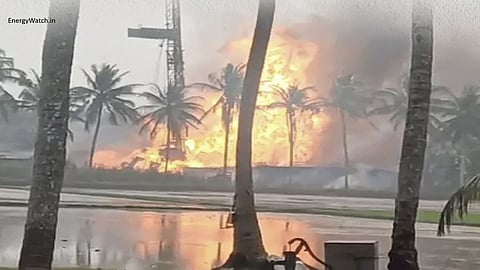
New Delhi: A gas leak incident at Oil and Natural Gas Corporation's (ONGC) Mori Field in Andhra Pradesh has triggered a rapid emergency mobilisation, underscoring both the operational risks inherent in deep-well workover operations and the state-owned producer's crisis response capabilities.
The incident, reported by Deep Industries Limited—the production enhancement contract (PEC) operator managing the facility—occurred during workover operations at Well Mori#5 on Sunday. While the exact volume and duration of the gas release remain undisclosed, ONGC's immediate response suggests a controlled but serious situation.
Remote location limits immediate danger
The geographic isolation of the facility has proven critical in containing the fallout. Mori Field lies in a remote area with minimal human habitation—no settlements within approximately 500–600 metres of the wellhead. ONGC confirmed that no injuries or fatalities have been reported.
However, the remoteness also presents logistical challenges. The well's distance from populated areas complicates access for emergency personnel and equipment, even as it reduces immediate public safety risks.
Response protocol activated
ONGC has deployed its standard crisis architecture: both Crisis Management Teams (CMT) and Regional Crisis Management Teams (RCMT) have been mobilised to the field. Cooling operations have already commenced, a standard procedure to stabilise pressure dynamics in a venting well.
The operational focus has shifted to well-control preparations. ONGC's statement indicates that preparatory work is underway to regain control of the well, with capping operations standing as a contingency option if conventional well-control measures prove insufficient.
The involvement of international well-control specialists marks an escalation in response strategy. ONGC is coordinating with overseas technical experts and arranging their mobilisation to the site, contingent on site assessment findings. Advanced well-control and casing-cutting operations—specialised procedures requiring expertise typically held by global well-intervention firms—are now under active consideration.
Equipment mobilisation from Narsapuram
ONGC has initiated equipment mobilisation from nearby operational hubs, particularly Narsapuram, an established logistics and equipment centre for the company's eastern operations. This supply-line activation suggests the incident may require sustained intervention rather than resolution through immediate containment alone.
Mori Field operations and context
The Mori Field represents part of ONGC's portfolio of shallow-water and onshore assets in the Bay of Bengal region. Workover operations—interventions conducted on existing wells to restore, enhance, or modify production—are routine in mature fields but carry inherent operational risks, particularly when dealing with high-pressure zones or unexpected formation conditions.
The deployment of a PEC operator reflects ONGC's increasingly common practice of outsourcing well management to specialist contractors, a model that distributes operational responsibility but centralises safety oversight at the parent company level.
What's next?
ONGC senior management is maintaining close monitoring of the situation, with technical experts from New Delhi engaged in real-time assessment and decision-making. The corporation has committed to releasing further updates as circumstances evolve, though no timeline has been specified for well stabilisation or resumption of normal operations.
The incident occurs against a backdrop of heightened scrutiny of operational safety in India's upstream sector, particularly following environmental incidents at other major facilities. For ONGC—which accounts for over 70% of India's domestic crude production—any extended operational disruption carries implications for national energy security and production forecasting.
Whether this incident resolves through well-control interventions or escalates to capping operations will likely determine its impact on field production schedules and ONGC's full-year performance metrics.
(PSU Watch– India's Business News centre that places the spotlight on PSUs, Bureaucracy, Defence and Public Policy is now on Google News. Click here to follow. Also, join PSU Watch Channel in your Telegram. You may also follow us on Twitter here and stay updated.)

