
- News Updates
- PSU Watch
- Defence News
- Policy Watch
- हिन्दी न्यूज़
- Jobs Watch
- States News
- Event News

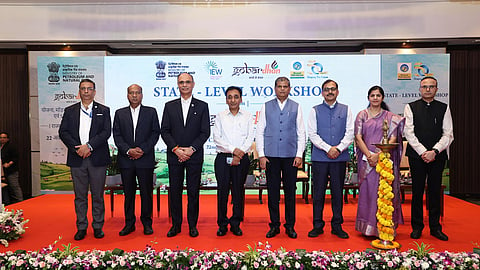
New Delhi: Bharat Petroleum Corporation Limited (BPCL) has organised a high-level workshop in Mumbai to accelerate the development of compressed biogas (CBG) projects in Maharashtra, with a focus on converting municipal and agricultural waste into clean energy and economic value.
Follow The PSUWatch Channel on Whatsapp
The workshop, titled “Waste to Wealth – Scaling GOBARdhan”, was organised in partnership with the Ministry of Petroleum and Natural Gas (MoPNG) and the Government of Maharashtra. It brought together Central and State Government officials, industry representatives, city gas distribution companies, urban local bodies, CBG developers, financial institutions, technology partners and Farmer Producer Organisations to identify measures for strengthening the state's CBG ecosystem.
The inaugural session was attended by Maharashtra Chief Secretary Rajesh Aggarwal; Additional Chief Secretary, Urban Development Department-2, K.H. Govind Raj; MoPNG Director (GP) Vikas Singh; Deputy Secretary (International Cooperation) Yashika Mehta; and BPCL Chairman and Managing Director Sanjay Khanna, Director (Marketing) Subhankar Sen and Director (Finance) V.R.K. Gupta.
Addressing the workshop, BPCL CMD Sanjay Khanna highlighted the potential of CBG to convert agricultural residues, cattle dung, press mud and municipal organic waste into renewable energy while supporting scientific waste management, sustainable agriculture and rural livelihoods.
He emphasised that the organic manure generated by CBG plants could improve soil fertility and strengthen the link between clean energy production and agriculture, creating a circular economy in which waste is converted into lasting value.
BPCL Chief General Manager (Biofuels) Inderjit Singh highlighted Maharashtra's resource potential, particularly municipal solid waste and press mud. Referring to the GOBARdhan initiative's theme of “Kachre se Kanchan” (turning waste into wealth), he called for treating waste as a resource for clean energy generation, agricultural sustainability and local economic development.
MoPNG Director (GP) Vikas Singh outlined the Centre's vision for expanding the GOBARdhan initiative and discussed the policy and market framework required to scale up CBG projects. He called for coordinated action among the Central and State governments, industry, urban local bodies, farmers and financial institutions.
Singh also urged the Maharashtra government to align its state policy with the broader CBG framework, establish a land bank for potential projects and undertake a detailed assessment of feedstock availability across the state.
Maharashtra Chief Secretary Rajesh Aggarwal highlighted the role of energy consumption in the country's development and stressed the need to utilise agricultural residues and municipal solid waste more efficiently. He said effective waste utilisation could promote clean energy production, improve waste management and create greater value for local communities.
MoPNG Deputy Secretary Yashika Mehta highlighted the importance of CBG in India's energy mix and shared the theme of India Energy Week (IEW) 2027, scheduled to be held in Kolkata.
A focused session conducted by MoPNG and BPCL's Corporate Research and Development Centre (CRDC) examined the potential of Enriched Fermented Organic Manure (EFOM) to support sustainable agriculture and improve soil health.
The workshop also featured presentations by the Centre for High Technology (CHT) and the Maharashtra government's Urban Development Department on the GOBARdhan Scheme, the Model State CBG Policy and the Scheme for Special Assistance to States for Capital Investment (SASCI) 2026-27. The discussions covered Maharashtra's CBG policy and the requirements for translating policy provisions into implementable projects.
Key issues identified during the deliberations included feedstock availability, assured offtake, stable pricing, financing, streamlined approvals and the development of supporting infrastructure. These factors were highlighted as critical to improving project viability and accelerating investment in the sector.
Follow PSU Watch on LinkedIN
Maharashtra has the potential to build a substantial CBG ecosystem by utilising its municipal organic waste, agricultural residues, cattle dung and press mud resources.
BPCL reiterated its commitment to supporting the sector as a CBG producer, offtaker and facilitator. The company emphasised collaboration among governments, urban local bodies, farmers, cooperatives, industry and financial institutions to accelerate project implementation and strengthen the state's waste-to-wealth ecosystem.
(PSU Watch is India's Business News centre that places the spotlight on PSUs, Bureaucracy, Defence and Public Policy. 👉 Click to join our channel now: PSUWatch WhatsApp Channel. Prefer LinkedIn? Follow PSU Watch on LinkedIN. Click to stay connected on Twitter here and stay updated.)

