
- News Updates
- PSU Watch
- Defence News
- Policy Watch
- हिन्दी न्यूज़
- Jobs Watch
- States News
- Event News

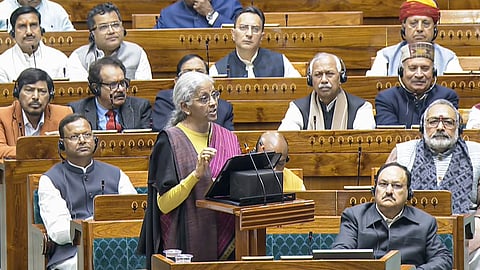
New Delhi: The Union Finance Minister Nirmala Sitharaman, while presenting the Union Budget 2026–27, announced a wide-ranging set of measures aimed at boosting manufacturing, logistics, digital infrastructure, clean energy, healthcare and ease of doing business, reinforcing the government’s long-term vision for inclusive and sustainable economic growth.
The Finance Minister announced a dedicated container manufacturing scheme with a total outlay of Rs 10,000 crore over five years to create a globally competitive ecosystem in the sector. To promote environmentally sustainable cargo movement, a new scheme for enhancement of construction and infrastructure equipment (CIE) will also be introduced to strengthen domestic manufacturing of high-value and technologically advanced equipment.
She further proposed the establishment of a new Dedicated Freight Corridor connecting Dankuni in the East to Surat in the West. The government will operationalise 20 new National Waterways over the next five years, starting with NW-5 in Odisha to connect mineral-rich Talcher and Angul with industrial hubs such as Kalinga Nagar and ports at Paradeep and Dhamra.
A ship-repair ecosystem for inland waterways will be developed in Varanasi and Patna, while a Coastal Cargo Promotion Scheme will incentivise modal shift from road and rail to waterways, increasing their share from 6 per cent to 12 per cent by 2047. Regional Centres of Excellence will also be set up to train manpower for the waterways sector.
The Finance Minister announced that the outlay for electronics manufacturing will be increased to Rs 40,000 crore in FY27, underlining the government’s continued focus on building India as a global electronics hub.
High-tech tool rooms will be established at two locations to support capital goods manufacturing, while three dedicated chemical parks will be set up to enhance domestic production and reduce import dependence. Mobile phone manufacturing has seen nearly a 30-fold increase over the past decade, with iPhone exports alone touching Rs 2.03 lakh crore in 2025.
As of August 2025, ten semiconductor manufacturing and packaging projects with a cumulative investment of Rs 1.6 lakh crore have been approved across six states.
To strengthen India’s pharmaceutical ecosystem, Sitharaman announced a Rs 10,000 crore investment over five years under the proposed Biopharma SHAKTI initiative to position India as a global biopharma manufacturing hub.
The initiative will focus on building domestic capabilities in biologics and biosimilars, supported by a network of three new National Institutes of Pharmaceutical Education and Research (NIPERs) and the upgradation of seven existing institutes. The government will also establish over 1,000 accredited clinical trial sites across the country and strengthen the Central Drugs Standard Control Organisation (CDSCO) through a dedicated scientific review cadre.
Additionally, basic customs duty will be exempted on 17 medicines, including cancer drugs, while seven more rare diseases will be added for duty-free personal imports of treatment-related medicines.
Sitharaman announced the extension of basic customs duty exemption on capital goods used for manufacturing lithium-ion cells for battery storage. Duty exemption will also be provided on the import of sodium antimony for manufacturing solar glass and on capital goods required for processing critical minerals in India.
For biogas-blended CNG, the entire value of biogas will be excluded while calculating central excise duty. The Budget also proposes removal of customs duty exemptions on items already manufactured domestically or having negligible imports.
The Finance Minister proposed the development of an integrated East Coast Industrial Corridor with a well-connected node at Durgapur. As part of the Poorvodaya initiative, five tourism destinations will be developed across five eastern states, alongside the deployment of 4,000 e-buses and development of Buddhist tourism circuits in the northeastern region.
Presenting the Budget, Sitharaman reaffirmed the government’s commitment to “Sabka Saath, Sabka Vikas”, positioning Budget 2026–27 as a blueprint for long-term growth driven by manufacturing, infrastructure, technology and human capital development.
In a major boost to digital infrastructure, the Finance Minister proposed a tax holiday till 2047 for foreign companies offering cloud services globally using data centres located in India, subject to specified conditions. Companies will be required to provide services to Indian customers through Indian reseller entities.
The government will also upgrade the National Council for Hotel Management into a National Institute of Hospitality and establish a second National Institute of Mental Health and Neurosciences (NIMHANS-2). In addition, key turtle nesting sites in Odisha, Karnataka and Kerala will be developed alongside eco-tourism initiatives.
Sitharaman proposed exempting Minimum Alternate Tax (MAT) for non-residents who pay tax on a presumptive basis. The safe harbour threshold for IT services will be increased sharply from Rs 300 crore to Rs 2,000 crore.
The government will rationalise the tax collected at source (TCS) rate on liquor, scrap and minerals to 2 per cent and revise the definition of accountants under safe harbour rules to encourage home-grown accounting firms. Inter-cooperative society dividend income will also be allowed as a deduction under the new tax regime.
(PSU Watch– India's Business News centre that places the spotlight on PSUs, Bureaucracy, Defence and Public Policy is now on Google News. Click here to follow. Also, join PSU Watch Channel in your Telegram. You may also follow us on Twitter here and stay updated.)

