
- News Updates
- PSU Watch
- Defence News
- Policy Watch
- हिन्दी न्यूज़
- Jobs Watch
- States News
- Event News

New Delhi: The Cabinet Committee on Economic Affairs (CCEA) on Tuesday approved enhanced delegation of powers to Power Grid, raising the permissible equity investment limit from Rs 5,000 crore per subsidiary to Rs 7,500 crore per subsidiary, while retaining the existing cap of 15 percent of the company’s net worth. The decision, taken under the Department of Public Enterprises (DPE) guidelines dated February 4, 2010, applies to Maharatna CPSEs.
According to an official statement, the approval “enhances the permissible equity investment limit of POWERGRID from the current threshold of Rs 5,000 crore per subsidiary to Rs 7,500 crore per subsidiary, while retaining the existing cap of 15 percent of the company's net worth.”
The move empowers POWERGRID’s Board to sanction investments up to Rs 7,500 crore per subsidiary under the revised delegation framework.
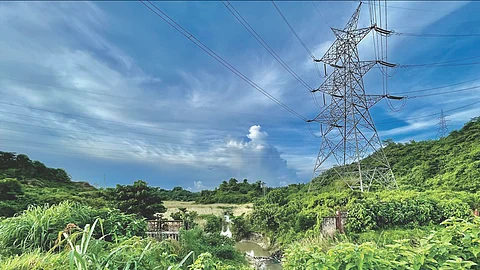
The government said the enhanced delegation will allow Power Grid to expand investments in its core transmission business and support renewable energy evacuation.
“The approval will enable POWERGRID, the largest and most experienced transmission service provider in the country, to expand its investment in its core business and support the evacuation of renewable energy capacity, helping achieve the target of 500 GW from non-fossil-based sources,” the statement said.
The decision will allow the company to bid for capital-intensive transmission projects, including Ultra High Voltage Alternating Current (UHVAC) and High Voltage Direct Current (HVDC) systems.
“Power Grid can now participate in the bids for capital-intensive transmission projects, such as Ultra High Voltage Alternating Current (UHVAC) and High Voltage Direct Current (HVDC) transmission networks,” the government said.
The Power Ministry said that several capital-intensive projects — including EHVAC, HVDC and synchronous condensers — are envisaged under the National Electricity Plan (2023–32) for grid modernisation and inter-regional connectivity.
The government also linked the decision to competitive bidding dynamics in transmission. “Additionally, it will broaden competition in the Tariff Based Competitive Bidding (TBCB) for selection of bidders for critical transmission projects. This ensures better price discovery, and will ultimately lead to the availability of affordable and clean energy for consumers,” the statement said.
The Power Ministry said that the enhanced delegation “will enable Power Grid’s participation in capital-intensive transmission projects under the Tariff Based Competitive Bidding (TBCB) mode” and broaden competition in critical projects.
Industry experts said the higher equity ceiling gives Power Grid greater financial flexibility as transmission project sizes increase, particularly in renewable energy corridors and long-distance HVDC links. An industry analyst tracking transmission investments said larger per-project equity approval limits could reduce delays in board-level clearances and improve responsiveness in TBCB bids for high-value projects.
Under DPE guidelines dated February 4, 2010, Maharatna CPSE boards can approve equity investments in subsidiaries, joint ventures and acquisitions up to 15 percent of net worth or Rs 5,000 crore per project, whichever is lower. At the end of the December quarter of FY2025-26, Power Grid's net worth stood at Rs 98,906.34 crore. Back of the envelope calculations show that 15 percent of its net worth would work out to be Rs 14,836 crore.
The decision comes as transmission investment requirements rise in line with renewable capacity growth and grid modernisation plans, with capital-intensive projects expected to form a larger share of upcoming bids.
(PSU Watch– India's Business News centre that places the spotlight on PSUs, Bureaucracy, Defence and Public Policy is now on Google News. Click here to follow. Also, join PSU Watch Channel in your Telegram. You may also follow us on Twitter here and stay updated.)

