
- News Updates
- PSU Watch
- Defence News
- Policy Watch
- हिन्दी न्यूज़
- Jobs Watch
- States News
- Event News
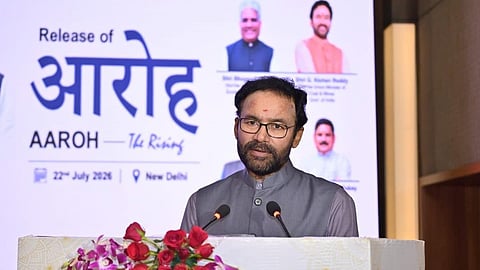
New Delhi: The Ministry of Coal released AAROH: Annual Report on Mine Closure, which it described as India's first comprehensive documentation of scientific mine closure and repurposing practices, at an event in New Delhi on Wednesday. The report, developed by the Coal Controller Organisation (CCO), documents 42 scientifically closed coal mines, with each profile carrying reclamation and post-mining land-use outcomes, before-and-after visuals, and QR code-linked documentary videos.
Follow The PSUWatch Channel on WhatsApp
The report was launched by Coal and Mines Minister G Kishan Reddy, Minister of State (Independent Charge) for Science & Technology, Earth Sciences and Prime Minister's Office (PMO) Dr Jitendra Singh, Minister of State for Coal Satish Chandra Dubey, German Ambassador Philipp Ackermann, EU Delegation Deputy Head Ewa Suwara, and Coal Secretary Vikram Dev Dutt. Reddy also inaugurated an exhibition on mine closure and repurposing, featuring Coal India Ltd and its subsidiaries, NLC India Ltd, Singareni Collieries Company Ltd (SCCL), NTPC and private miners.
At the event, the ministry signed an implementation agreement with Germany's Deutsche Gesellschaft für Internationale Zusammenarbeit (GIZ) for technical cooperation on mines that are to be closed. According to the release, the project has been commissioned by Germany's Federal Ministry for Economic Cooperation and Development and co-financed by the European Union, with a total project volume of EUR 10 million until 2030, and the cooperation will run over the next four years. The ministry said the agreement covers scientific mine closure, repurposing, capacity building and knowledge exchange.
The ministry said AAROH captures the evolution of India's mine-closure framework and its key policy instruments, including the RECLAIM Framework, the LIVES Framework, the SUVIKALP mine-repurposing tool, and the Mine Closure Guidelines, 2025. It said reclaimed mine land is being repurposed for renewable energy, eco-tourism, water conservation, agriculture and community infrastructure, citing sites at West Bokaro, Bishrampur and the Viveknagar Solar Project.
Union Minister of State Jitendra Singh said the closure of 42 mines showed how degraded land could be converted into productive assets, and that the effort embodied circular-economy principles. He said "the time has come to change the phrase from mine closure to mine of wealth," and reaffirmed India's target of reaching net zero by 2070.
Reddy also virtually inaugurated Coal NEER plants set up by Coal India through its subsidiaries Bharat Coking Coal Ltd (BCCL), Central Coalfields Ltd, Mahanadi Coalfields Ltd (MCL) and South Eastern Coalfields Ltd (SECL). The ministry said the plants treat mine water into bottled drinking water using reverse osmosis, ultraviolet and capacitive deionisation methods, and are marketed under the Coal Neer brand, with distribution handled in part by local self-help groups.
Coal Secretary Vikram Dev Dutt said coal public-sector undertakings supply nearly 300 lakh kilolitres of treated mine water annually, benefiting around three lakh people, including the supply of drinking water to Chennai.
The event also saw the signing of tripartite memorandums of understanding by BCCL and the Jharia Rehabilitation and Development Authority (JRDA) with Hindalco Industries Ltd and Rajdhani Universal Fabrics Pvt Ltd. The ministry said the Hindalco agreement is aimed at setting up an industry-linked skill centre for apparel manufacturing in the Dhanbad region, while the Rajdhani Universal Fabrics agreement is aimed at establishing a technical-textile manufacturing facility. Dutt said the Revised Jharia Master Plan includes a plug-and-play textile manufacturing facility for rehabilitated families.
Follow PSU Watch on LinkedIN
In his address, Reddy said India had scientifically closed 42 coal mines, including 33 in the past year, and had set a target of closing 147 more over the next two to three years. He said that, for the first time, 25 percent of the approved mine-closure cost had been earmarked for community development, which he put at an investment potential of nearly Rs 10,000 crore over the next decade. He also said the government had created a dedicated corpus of over USD 5 billion, or about Rs 40,000 crore, for scientific and progressive mine closure.
Dubey said the ministry's approach was guided by the principle that environmental restoration and socio-economic development must progress together. Ackermann said the GIZ collaboration would facilitate the exchange of technical expertise for scientific mine closure, while Suwara said the agreement represented a practical step forward in India-EU cooperation on a fair and inclusive transition.
(PSU Watch is India's Business News centre that places the spotlight on PSUs, Bureaucracy, Defence and Public Policy. 👉 Click to join our channel now: PSUWatch WhatsApp Channel. Prefer LinkedIn? Follow PSU Watch on LinkedIN. Click to stay connected on Twitter here and stay updated)

