
- News Updates
- PSU Watch
- Defence News
- Policy Watch
- हिन्दी न्यूज़
- Jobs Watch
- States News
- Event News

New Delhi: India's economy expanded 7.8 percent in the April-June quarter of 2026-27, significantly exceeding expectations and the Reserve Bank of India's 7 percent projection, as strong domestic economic activity helped offset concerns over geopolitical tensions, energy market disruptions and global uncertainty.
The growth rate, while lower than the 8.6 percent expansion recorded in the preceding quarter, was substantially higher than the 6.9 percent recorded in the April-June quarter of 2025-26, according to data released by the Ministry of Statistics and Programme Implementation (MoSPI) on Monday.
Follow The PSUWatch Channel on WhatsApp
The latest numbers indicate that the Indian economy entered FY27 with considerable momentum despite a challenging external environment.
The 7.8 percent growth also keeps India among the fastest-growing major economies, with domestic demand, manufacturing and investment providing important support during the quarter.
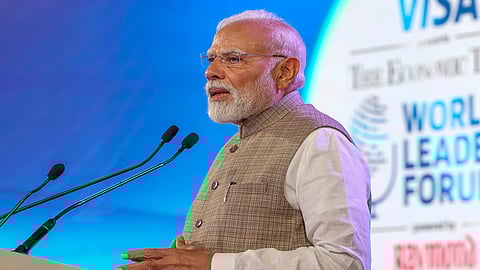
Prime Minister Narendra Modi described the performance as a "herculean feat", saying India's economy had delivered strong growth despite oil price shocks and supply-chain disruptions amid global uncertainty.
In a post on X, Modi also criticised those questioning the state of the economy, saying "doomsayers were doomed and India bloomed yet again".
Finance Minister Nirmala Sitharaman attributed the performance to the combination of economic reforms and management of the economy.
"The credit for this strong performance goes to the people of India and their hard work. Reforms undertaken by the NDA Government, together with an agile management of the economy, are bearing results," she said in a post on X.
Real GDP at constant prices was estimated at Rs 81.36 lakh crore in Q1FY27, compared with Rs 75.46 lakh crore in the corresponding quarter of the previous fiscal, representing a 7.8 percent increase.
Nominal GDP at current prices rose 10.3 percent to an estimated Rs 88.27 lakh crore from Rs 80 lakh crore in Q1FY26.
Gross value added (GVA) at basic prices increased 8.2 percent in real terms to Rs 73.82 lakh crore from Rs 68.21 lakh crore a year earlier.
Nominal GVA grew 11.5 percent to Rs 80.53 lakh crore from Rs 72.24 lakh crore.
Manufacturing was among the major contributors to the expansion, with GVA in the sector growing 9.2 percent in real terms. The secondary sector as a whole expanded 8.6 percent during the quarter.
Investment activity also strengthened considerably. Gross fixed capital formation (GFCF), a measure of investment in fixed assets, grew 11.9 percent in Q1FY27, compared with 5.8 percent a year earlier.
The improvement in investment growth provides an important support to the broader expansion, particularly as India seeks to sustain its growth momentum amid a less certain global environment.
Agriculture, livestock, forestry and fishing recorded 3.6 percent growth in real GVA during the quarter. Mining and quarrying, however, contracted 2.4 percent.
CEA sees strong domestic momentum but warns of global risks
Chief Economic Adviser V Anantha Nageswaran said the resilience reflected in the GDP numbers was supported by high-frequency economic indicators.
He said domestic economic momentum remained strong in the near term, while cautioning that uncertainty in the global economy continued.
Nageswaran flagged risks relating to interest rates, energy commodity supplies and food prices, while noting that several global developments remained unresolved.
He said there could eventually be an impact on India's economic activity, but added that strong domestic momentum and export performance had combined to deliver another quarter of robust growth.
According to the CEA, the latest performance also reflects the benefits of structural reforms implemented over the past 12 years.
Follow PSU Watch on LinkedIN
The strong first-quarter performance does not mean the risks to India's growth outlook have disappeared.
Crisil Chief Economist Dharmakirti Joshi said real GDP growth had continued to outperform expectations despite geopolitical headwinds arising from the West Asia conflict.
He attributed the resilience to India's domestic economic fundamentals and its ability to navigate an increasingly uncertain global environment.
CareEdge Ratings Chief Economist Rajani Sinha also said the domestic economy had demonstrated resilience in Q1FY27 but expected growth to moderate in the coming quarters.
She identified geopolitical tensions and uncertainty over trade policy as key risks to the outlook. On the domestic front, weather-related uncertainties and the potential impact of El Niño conditions could affect agricultural output and yields.
The 7.8 percent Q1 growth gives FY27 a strong opening, with manufacturing and investment emerging as important sources of support. However, sustaining the pace will depend increasingly on how the domestic economy absorbs external shocks.
Energy prices, global interest rates, trade-policy changes, geopolitical tensions and weather conditions could all influence the trajectory of growth over the remainder of the fiscal year.
For now, the latest data suggests that domestic economic momentum has remained stronger than anticipated despite the deterioration in the global environment. The bigger test for the economy will be whether that resilience can be maintained through the subsequent quarters of FY27.
(PSU Watch is India's Business News centre that places the spotlight on PSUs, Bureaucracy, Defence and Public Policy. 👉 Click to join our channel now: PSUWatch WhatsApp Channel. Prefer LinkedIn? Follow PSU Watch on LinkedIN. Click to stay connected on Twitter here and stay updated)

