
- News Updates
- PSU Watch
- Defence News
- Policy Watch
- हिन्दी न्यूज़
- Jobs Watch
- States News
- Event News


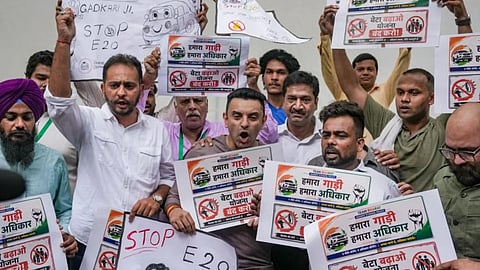
New Delhi: The simmering discontent over ethanol-blended petrol produced a remarkable split-screen this weekend: on July 4, seven of the country's biggest automakers lined up at a government-organised press conference to declare E20 fuel safe and rigorously tested, and on July 5, motorists gathered at Delhi's Jantar Mantar for what organisers called the country's first on-ground protest against the very same fuel, alleging falling mileage, engine trouble and mounting repair bills, while demanding the right to choose what goes into their tanks.
Follow The PSUWatch Channel on WhatsApp
The escalation marks the moment India's E20 backlash moved decisively out of social media timelines and into public space for the first time.
The July 5 demonstration at Jantar Mantar was organised under the banner "Hamaari Gaadi, Hamaara Adhikaar" (our vehicle, our right) by entrepreneur and television personality Tehseen Poonawalla, along with his advocacy initiative Team Bharat. Protesters alleged the government's push to 20 percent ethanol-blended petrol had been implemented too quickly, without adequately addressing consumer concerns. Placards at the venue read "Our Vehicles, Our Rights," while another said, "You promised development, not damage... Gadkari ji, stop E20."
The protest marked the culmination of a long-brewing discontent against E20 fuel on social media where car owners, two-wheeler owners and car gurus have repeatedly slammed the fuel, claiming that it causes damage to the vehicle engine.
At the protest site, vehicle owners shared accounts of poor fuel efficiency, clogged fuel systems, rough engine performance and higher maintenance costs after switching to E20. One protester, an IT professional from Gurugram, told reporters at the venue that the mileage of his 2018 car had dropped sharply after he began using E20 petrol; a Delhi resident said his car developed problems after months on the blended fuel and his repair bill had crossed Rs 35,000. "The cost of running the bike has increased because it now requires more frequent maintenance visits," said a motorist.
Poonawalla listed four demands on X after the protest: "Availability of E0 E5, E10 & E20 blended fuels!; all documents wrt E20, including ARAI report in public domain; solution for pre-2023 vehicles damged; no future rollout without 360° infrastructure being ready" (sic).
Notably, he clarified the protesters were not asking the government to withdraw E20 from pumps, but to offer all blends so consumers could choose. "The middle class feels cheated because their hard-earned money has gone into buying these vehicles. The way ethanol blending has been implemented is what is bringing people out," Poonawalla had said ahead of the protest. On the road ahead, he said, "Our demand is simple: don't move to E25 or E30 without consulting the public and without creating a complete ecosystem first."
The protest came less than 24 hours after the Ministry of Petroleum and Natural Gas, along with the Ministries of Heavy Industries and Road Transport and Highways, organised a press conference in New Delhi where executives from Maruti Suzuki, Toyota Kirloskar Motor, Hero MotoCorp, TVS Motor, Hyundai Motor India and Bajaj Auto, alongside former Engineers India Ltd CMD Vartika Shukla, mounted a collective defence of the E20 programme.
Rahul Bharti, Senior Executive Officer, Corporate Affairs, at Maruti Suzuki, offered what the government's account of the presser described as a "statement of confidence" to customers. According to the official statement, of the 2.84 crore cars serviced by Maruti Suzuki in FY 2025-26, more than 1.5 crore were over three years old, and hence not E20-certified, and no E20-related issues of corrosion, wear and tear or damage to component life were reported from the field.
On the mileage question at the heart of consumer anger, Bharti said the calorific value of E20 is lower than that of E10 by about 3 to 3.5 percent, and the mileage impact is limited to this extent — roughly 0.6 km per litre for a car giving 20 km per litre, a government statement said, adding that factors such as tyre pressure, driving pattern and maintenance cause far greater variation.
Vikram Gulati, Country Head and Executive Vice President at Toyota Kirloskar Motor, said, "Vehicles that are made available to consumers are extremely well engineered, well designed and have a very immense element of oversight through technically sound testing agencies." Calling ethanol "a very good fuel", he added, "In an era when we are facing the issue of climate change... this is a zero carbon fuel because it's derived from plants."
Hero MotoCorp Chief Business Officer Ashutosh Varma said the company had analysed extensive service data from its two-wheelers. "We analyse crores of service data that we have, and there is no incidence whatsoever of any higher damage with vehicles that run on E20 than the vehicles that were running on fuels prior to E20," he said.
Shukla said the ethanol blending programme "has been not done overnight, it is a measured scientifically driven step-by-step process," and noted that E20 conforms to the BIS standard and BS-VI emission norms.
Follow PSU Watch on LinkedIN
The industry's united front contrasts sharply with scores of accounts and the daily experiences of vehicle owners who came to protest against any further follout of ethanol-blended fuels. A key area of concern, as recognised by Maruti's Bharati, is vehicles built before the 2023 E20 material-compliance mandate for automobile makers: "That is the central question which needs to be addressed," he said. Along with demanding more choices at retail outlets, protesters have also demanded making a report by Automotive Research Association of India (ARAI) on the impact of E20 fuel on car engines.
The Centre has held its line through the week. Union Petroleum Minister Hardeep Singh Puri, speaking on July 2, acknowledged a limited efficiency impact: "They use it (ethanol as additive) in racing cars also, the acceleration increases. Mileage, yes, it may drop a little." Addressing the media in Jodhpur on July 4, he said, "I welcome criticism. If you feel there are shortcomings in the work we are doing, please point them out," while dismissing claims that E20 attracts pests or damages engines as "rumours."
The ministry's July 2 note also rejected viral claims that producing one litre of ethanol consumes 10,000 litres of water, and said manufacturers and insurers have clarified that E20-approved vehicles remain covered under existing warranty and insurance terms.
India completed its 20 percent ethanol blending target in December 2025, five years ahead of the original 2030 schedule, an acceleration the government credits for import savings and energy security, and which protesters cite as evidence of a rollout that outpaced vehicle compatibility. With the government signalling eventual movement towards higher blends, and Team Bharat vowing to resist any rollout without what it calls full infrastructure readiness, the weekend's split-screen is unlikely to be the last.
(PSU Watch is India's Business News centre that places the spotlight on PSUs, Bureaucracy, Defence and Public Policy. 👉 Click to join our channel now: PSUWatch WhatsApp Channel. Prefer LinkedIn? Follow PSU Watch on LinkedIN. Click to stay connected on Twitter here and stay updated)
