
- News Updates
- PSU Watch
- Defence News
- Policy Watch
- हिन्दी न्यूज़
- Jobs Watch
- States News
- Event News

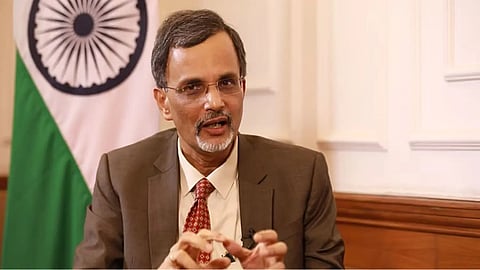
New Delhi: Macro stability and supply measures can bring back India on a 7 percent growth trajectory in FY28, Chief Economic Adviser V Anantha Nageswaran said on Friday, asserting that the growth is contingent on improvement in external conditions.
The Reserve Bank on Friday lowered its GDP forecast for FY27 to 6.6 percent from the 6.9 percent estimated in April, citing elevated energy and other commodity prices, as well as continued supply disruptions arising from the conflict in West Asia, which are likely to weigh on economic activity.
Follow The PSUWatch Channel on WhatsApp
"We have no reason to second-guess them (RBI forecast) at this point, because there are both possibilities on the upside and on the downside with respect to the numbers that they have presented," he said here.
"So, even if the growth were to slip below 7 percent as the RBI forecast suggests...macro stability measures and supply assurances will bring us back to a 7 percent plus growth track in FY28 or as soon as external conditions improve," he added.
He further said it is a hope based on the assumption that the pre-February 28 condition is restored before FY28.
"Now, if these conditions continue, then we will revisit the estimate for the next financial year," he added.
Talking about nominal GDP, he said, it is a fair estimate that it will overshoot the 10.1 percent estimated in the Budget 2027, given the upward momentum of retail inflation.
"The good news is that the nominal GDP growth will be significantly higher than the number which the budget estimates used, which is 10.1 percent for the current financial year," he said.
With regard to the overall trade deficit, Nageswaran said it widened in FY26, and a similar trend with potentially wider deficits is possible in FY27.
The evolving West Asia crisis represents both a significant supply shock and a potential demand shock, he said.
However, he said, most high-frequency indicators up to April 2026 suggest that domestic demand and overall economic activity in India have remained relatively resilient so far, with emerging signs of stress.
Supply-side price pressures are beginning to emerge in wholesale inflation, he said.
In addition, he said, the India Meteorological Department's forecast of monsoon rainfall at 90 percent of the Long Period Average (LPA) poses upside risks to the inflation outlook.
"India’s merchandise and overall trade deficit widened in FY26. A similar trend, potentially with wider deficits, is likely in FY27, putting further pressure on the current account," he said.
Policy measures undertaken will help contain supply-side disruptions, create safety nets (ECLGS 5.0) and maintain macroeconomic stability, he added.
Improved policy certainty resulting from successful trade agreements, including progress on India-US and India-EU trade, is expected to support exports and capital flows, the CEA said.
Follow PSU Watch on LinkedIN
However, he said, prevailing global uncertainty continues to weigh on capital flow dynamics.
Continued pursuit of structural reforms during this period of global uncertainty will strengthen India’s economic foundations and position the country for sustained high growth in the years ahead, he added.
(PSU Watch is India's Business News centre that places the spotlight on PSUs, Bureaucracy, Defence and Public Policy. 👉 Click to join our channel now: PSUWatch WhatsApp Channel. Prefer LinkedIn? Follow PSU Watch on LinkedIN. Click to stay connected on Twitter here and stay updated.)

