
- News Updates
- PSU Watch
- Defence News
- Policy Watch
- हिन्दी न्यूज़
- Jobs Watch
- States News
- Event News

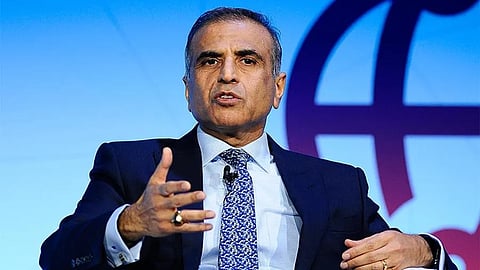
New Delhi: India must retain sovereign control over satellite communication networks operating within its territory to prevent foreign companies or governments from disrupting critical connectivity during conflicts or national emergencies, Bharti Airtel Founder and Chairman Sunil Bharti Mittal has said.
As India prepares to roll out commercial satellite broadband services, Mittal warned that control over the technology’s so-called “kill switch” must remain within the country, underscoring the growing national security implications of dependence on foreign-controlled space infrastructure.
“The kill switch, as we call it, should not be sitting somewhere else,” Mittal told PTI in an interview marking 50 years of Bharti Enterprises. “India must have control over its own space destiny.”
A satellite communication kill switch refers to the technical capability to suspend, restrict or disable connectivity for individual terminals, geographical regions or entire networks.
In a conflict, such control could determine whether military units, surveillance systems, emergency responders and critical civilian infrastructure retain access to essential communications.
If the ability to disable services rests with a foreign operator, India could face the risk of critical communication networks being disrupted by decisions taken outside its jurisdiction.
Conversely, sovereign control would allow Indian authorities to enforce lawful security restrictions, monitor communications under applicable rules and respond to threats without depending entirely on overseas network operators.
Mittal’s remarks come as the government finalises security clearances, domestic gateway requirements and monitoring safeguards for satellite broadband operators.
Highlighting the growing military dependence on satellite connectivity, Mittal pointed to Ukraine, where satellite broadband has become an important component of battlefield communications.
Ukraine recently accused Elon Musk’s SpaceX of restricting Starlink connectivity speeds, allegedly disrupting military operations and affecting the effectiveness of certain strike and interceptor drones. The allegations underscore concerns about relying on privately controlled satellite infrastructure during armed conflicts.
Mittal argued that future warfare would increasingly depend on space-based systems, making sovereign control over communications infrastructure a strategic necessity.
“Whether it’s drone or it’s cyber issues, or indeed guided missiles and all, they’re all going to be managed from space,” he said.
“Everybody in the world needs to have control over its security,” he added, stressing that India must establish appropriate safeguards.
Mittal also cautioned against concentrating satellite communication infrastructure in the hands of a single provider, arguing that strategic resilience requires multiple operators.
“Importantly, it may need to have different players. You can’t just depend on one country or one company,” he said.
He emphasised the need to secure satellite terminals, ground infrastructure and communication networks while ensuring that traffic is routed through India and remains subject to domestic security oversight.
Such requirements would be particularly significant for defence establishments, border surveillance, maritime security and disaster-response operations, where uninterrupted connectivity can be critical.
Mittal said Eutelsat OneWeb, in which Bharti has a significant investment, has already demonstrated operational satellite connectivity in India and is awaiting final government approval for commercial services.
“The government occasionally uses their terminals for emergency services,” he said.
“We were the first licence given by the government. We have satisfied all their needs, and we just now wait for their signal,” Mittal said, expressing hope that OneWeb would secure the first approval.
He also highlighted OneWeb’s involvement in developing secure European satellite communications infrastructure, referring to planned European investments of 14–15 billion euros.
Currently, Jio, OneWeb and Starlink hold satellite communication licences in India. The government has indicated that all three operators have provisional spectrum access and are at comparable stages of readiness, with commercial launches subject to final security clearances.
Mittal said satellite broadband would complement rather than replace terrestrial telecom networks, particularly in remote and strategically important regions where conventional infrastructure remains inadequate.
These include mountainous border areas, dense forests, isolated rural settlements, offshore locations and maritime zones.
Satellite connectivity could also provide an alternative communication channel during natural disasters or disruptions to terrestrial networks.
However, Mittal acknowledged that satellite broadband remains significantly more expensive than fibre and mobile networks because satellites require periodic replacement.
“For the foreseeable future it will remain complementary. It’s very expensive. Satellites need to be replaced every five, six years,” he said.
The larger national security question is no longer merely which company will launch satellite internet services first, but who will ultimately control the networks on which India’s defence preparedness, emergency communications and strategic connectivity could increasingly depend.
(PSU Watch is India's Business News centre that places the spotlight on PSUs, Bureaucracy, Defence and Public Policy. 👉 Click to join our channel now: PSUWatch WhatsApp Channel. Prefer LinkedIn? Follow PSU Watch on LinkedIN. Click to stay connected on Twitter here and stay updated)
