
- News Updates
- PSU Watch
- Defence News
- Policy Watch
- हिन्दी न्यूज़
- Jobs Watch
- States News
- Event News


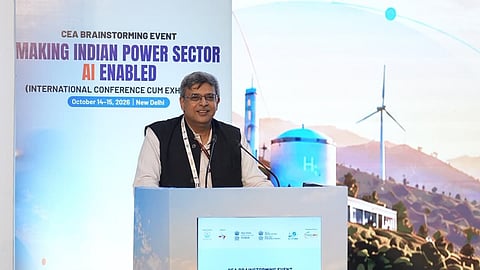
New Delhi: India is on target to meet the Central Electricity Authority’s (CEA) projection for battery storage capacity by 2030, Mayank Tewari, Additional Secretary at the Ministry of New and Renewable Energy (MNRE), said on Wednesday. “We will certainly be on target to meet all of those,” Tewari told reporters on the sidelines of the CEA’s Brainstorming Conclave on “Making Indian Power Sector AI Enabled.”
Follow The PSUWatch Channel on Whatsapp
He put the CEA’s projection at “roughly around 208 gigawatt hour for up to 2030.” The pace of additions this year is what places the target within reach, he said. “So I think the roadmap ahead is very clear. We will have accelerated growth.”
India’s installed battery energy storage system (BESS) capacity has grown roughly nine-fold since January, according to Tewari. “When we began this year in January, we had less than 1 gigawatt hour of installed capacity,” he said. “As I recall, we were a shade under 9 gigawatt hour last month. This is a figure that is growing quickly.”
More capacity is already in the pipeline. Current tenders have called for “almost 43 GWh,” Tewari said. The third phase of the Green Energy Corridor (GEC-3), a transmission scheme, carries “around an additional 50 GWh” of BESS on top of that. “We expect this only to grow at a reasonably fast rate going ahead,” he said.
The Union Cabinet cleared GEC-3 “around 15 days ago,” Tewari said, describing it as “one of the largest schemes that has ever come out.” The scheme is meant to address curtailment of renewable energy (RE). He said curtailment is a worldwide pattern that follows any sudden growth in generation. Generation capacity can come up faster because of the modular nature of its installation, while “transmission lines will always come up later.” “That’s a global trend, it’s not unique to India. What is unique to India is our ability to address it,” he said.
Transmission lines are normally not subsidised, Tewari said, but the government offered Central Financial Assistance (CFA) for lines built for RE. It first did so under the first two phases of the corridor. “So we tried the GEC 1 and 2, which we found was very useful,” he said. The third phase lets states set up transmission lines at identified locations and on critical projects where RE needs to be evacuated. “Once this is in place, we expect that we shall get close to 135 gigawatt of energy evacuated because of GEC 3,” he said.
Falling battery prices have changed how RE is procured, according to Tewari. “With the dropping costs of BESS, it is becoming a very, very viable option for our country,” he said. Solar and wind are complementary but intermittent. Scaling them up as standalone sources made sense in the early years, he said. That changed once RE became a major contributor to the grid, because “it becomes extremely important now to make sure that it remains flexible, remains available and remains affordable,” Tewari added.
Tenders now reflect that shift. “If you would now see, the tenders that are coming out are no longer pure vanilla solar or pure wind,” Tewari said. They are increasingly for round-the-clock renewable energy (RE-RTC) instead. “The trend now is going to be RE-RTC,” he said. “The trend now is going to be looking at what the consumer wants and designing tenders to meet the requirement of the end user.”
Blending a reasonable share of BESS with solar and wind is what makes such tenders possible, Tewari said, because end users then get power matched to their load profile. As a result, he said, “we are becoming less worried about where the electron is coming from and more concerned about the manner in which the electron will be made available to the end consumer.”
Follow PSU Watch on LinkedIN
Solar Energy Corporation of India (SECI) “very recently” discovered a tariff of Rs 5.25 a unit for near round-the-clock power, Tewari said. The rate is ex-bus, meaning at the generation point, and covers “around a gigawatt of power.” The contract was designed around what distribution companies would want, he said.
Asked about the power demand of data centres, Tewari said “there is a conscious decision that we will support data centres going ahead.” The fit works for India because many data centres are now seeking green power, he said. “They have a commitment for green power,” he said. “One of the advantages of course is that this ends up defining a clear load centre.”
(PSU Watch is India's Business News centre that places the spotlight on PSUs, Bureaucracy, Defence and Public Policy. 👉 Click to join our channel now: PSUWatch WhatsApp Channel. Prefer LinkedIn? Follow PSU Watch on LinkedIN. Click to stay connected on Twitter here and stay updated.)
