
- News Updates
- PSU Watch
- Defence News
- Policy Watch
- हिन्दी न्यूज़
- Jobs Watch
- States News
- Event News

New Delhi: India, the United States and the United Arab Emirates have stepped up diplomatic consultations on regional energy security as escalating tensions in West Asia threaten global oil supplies and international maritime trade.
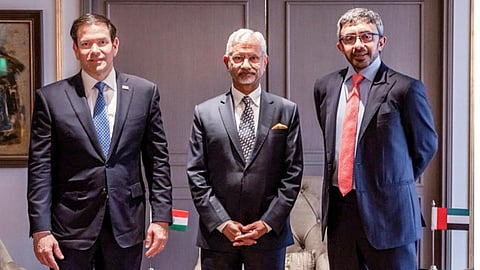
External Affairs Minister S Jaishankar, US Secretary of State Marco Rubio and UAE Foreign Minister Sheikh Abdullah bin Zayed Al Nahyan held trilateral talks in Mumbai on Tuesday, focusing on energy security, economic cooperation, regional connectivity and the deteriorating security situation in West Asia.
Rubio arrived in Mumbai on Tuesday afternoon, while the UAE foreign minister began his two-day India visit on Monday evening.
Follow The PSUWatch Channel on Whatsapp
“It was great to meet with Indian External Affairs Minister @DrSJaishankar and UAE Foreign Minister @ABZayed to discuss regional energy security and advance our shared economic priorities,” Rubio said in a social media post.
Jaishankar described the discussions as a “useful exchange of perspectives on energy, connectivity and contemporary developments.”
The meeting comes amid severe disruptions to global energy supplies following Iran’s blockade of the Strait of Hormuz, one of the world’s most strategically important oil transit routes.
Nearly 20 percent of global petroleum flows normally pass through the narrow waterway, making any prolonged disruption a major concern for oil-importing economies, including India.
The three foreign ministers are understood to have extensively reviewed the security situation in West Asia and the economic consequences of the continuing blockade.
For India, which depends heavily on imported crude oil, prolonged disruptions could increase energy costs, strain the import bill and intensify inflationary pressures.
Regional tensions have escalated further following a series of Houthi attacks on Saudi Arabia, including strikes targeting civilian infrastructure and strategically important energy assets.
The Iran-backed Houthi group has also targeted Saudi Arabia’s East-West oil pipeline, a critical alternative route for crude exports following disruptions to shipping through the Strait of Hormuz.
The pipeline allows Saudi Arabia to transport crude from its eastern oil-producing regions to terminals on the Red Sea, reducing dependence on the Hormuz shipping corridor.
Any damage to this infrastructure could further constrain global oil supplies at a time when international energy markets are already under pressure.
India has expressed serious concern over attacks on Saudi Arabia’s civilian infrastructure and economic assets, warning that such actions threaten regional stability and maritime security.
Beyond the Strait of Hormuz, the security of the Bab-el-Mandeb strait has emerged as another major concern.
Located between the Arabian Peninsula and the Horn of Africa, Bab-el-Mandeb connects the Red Sea with the Gulf of Aden and the Arabian Sea, serving as a vital maritime passage for international trade and energy shipments.
Houthi attacks have raised fears of disruptions along this route, potentially threatening commercial shipping and increasing transportation and insurance costs.
With two critical maritime chokepoints facing security threats, the risk to global energy supply chains has intensified.
Follow PSU Watch on LinkedIN
The Mumbai trilateral meeting highlights the growing importance of coordinated diplomatic efforts among India, the US and the UAE to protect energy supplies and maintain the security of international shipping routes.
While the three countries share substantial economic and strategic interests, the immediate challenge remains preventing the West Asia conflict from causing prolonged disruptions to oil shipments and global trade.
For India, the stakes extend beyond diplomatic engagement. Any sustained disruption to Gulf energy exports or Red Sea shipping could have significant consequences for domestic fuel prices, industrial costs, inflation and economic growth.
(PSU Watch is India's Business News centre that places the spotlight on PSUs, Bureaucracy, Defence and Public Policy. 👉 Click to join our channel now: PSUWatch WhatsApp Channel. Prefer LinkedIn? Follow PSU Watch on LinkedIN. Click to stay connected on Twitter here and stay updated.)

