
- News Updates
- PSU Watch
- Defence News
- Policy Watch
- हिन्दी न्यूज़
- Jobs Watch
- States News
- Event News


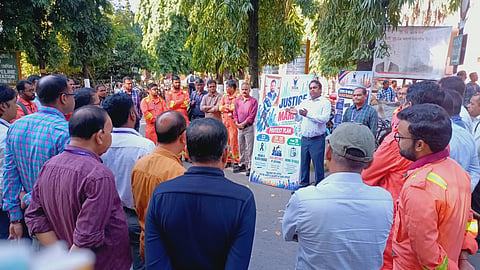
New Delhi: The Indian Oil Officers' Association (IOOA) launched a series of protests on October 23 to demand justice for Indian Oil Corporation (IOC) manager Mahesh Shelke and stronger safety measures for officers, it said on Monday. The protests began with officers wearing black badges and moved to gate meetings from October 24. Officers will work to rule from October 30. The association also sought a fast-tracked charge sheet in the case and the appointment of a special public prosecutor.
The association is escalating a nationwide protest over the killing of Shelke.
Follow The PSUWatch Channel on Whatsapp
Shelke, 37, Manager (Retail Sales), was stabbed to death on October 6 while taking over a shut IOC petrol pump in Maharashtra's Hingoli district. He was the field officer for IOC's Nanded North Retail Sales Area. The IOOA, which said it represents over 18,000 IOC officers, said his death had "deeply saddened the officer fraternity and raised serious concerns regarding the safety of officers, particularly those working in the field."
The incident, the association said, "reinforced the need for effective security mechanisms, institutional accountability and concrete preventive measures to ensure that officers can perform their professional responsibilities without fear." It said it had launched a phased protest to press for "decisive, meaningful and time-bound action" on its demands.
The protest began with officers wearing black badges on October 23, according to the statement. Gate meetings at various locations followed from October 24 and will run until October 29. The work-to-rule programme will start the next day. The association said this reflected "the collective resolve of officers to pursue their demands through organised and democratic means."
IOOA said officers across the country had participated enthusiastically. Through the protest, it said, it sought "to draw attention to the gravity of the incident and emphasise the urgent need for concrete action on the issues raised by the association."
On October 7, the IOOA had written to IOC's Director (HR) to place on record "its strongest protest" over Shelke's death, PSU Watch had reported. The letter served as formal notice of protest, with 15 days' prior intimation.
The association listed four demands to the management, according to the statement. The first sought justice for Shelke through "fast-tracking the filing of the charge sheet and appointment of a Special Public Prosecutor to facilitate effective prosecution and the pursuit of justice."
The second concerned Shelke's family. IOOA asked the management to consider and fulfil the demands submitted by the family "with compassion, sensitivity and urgency."
The third sought time-bound resolution of all demands in its protest notice. In the October 7 letter, IOOA had asked for comprehensive standard operating procedures (SOPs), mandatory risk assessment, and police or security support for sensitive assignments. It had also sought institutional legal support for officers, stronger security at vulnerable locations and better facilities at remote and difficult postings.
IOOA also called for "a robust Standard Operating Procedure (SOP) to address safety concerns and strengthen the security of officers." This should cover officers "engaged in field operations and assignments involving potential risks," the association said.
"Officers should be able to discharge their duties without fear or apprehension regarding their personal safety," IOOA said. The association said the safety and security of officers "must be accorded the highest priority." It urged the management to address all its demands "with the seriousness, sensitivity and urgency they deserve."
Shelke was killed at Sai Umesh Petrol Pump at Chondi Station. According to the first information report (FIR), the pump's dealer, Saheb Sopanrao Pandvir, had kept the outlet shut since February. IOC told him repeatedly to run it as company rules required, and later served him formal notices. When the pump stayed shut, the company sent Gullakuntla Maniprasad, a senior manager overseeing sales in the Nanded, Latur, Parbhani and Hingoli divisions, to take control of it. Shelke went with him.
The team spent the afternoon inspecting the pump. As the officials prepared to leave at about 4 pm, the dealer's son, Umesh Pandvir, attacked Shelke with a dagger and stabbed multiple times, the FIR said. He was taken by ambulance to Basmat, where his colleagues learnt that he had died.
Kurunda police registered the FIR on Maniprasad's complaint. On October 7, PSU Watch reported, citing sources, that the police had arrested all five accused. They included Umesh Pandvir, Lata Pandvir, Shravan Wakude and Rahul Dhaije, the sources said. Police invoked sections of the Bharatiya Nyaya Sanhita (BNS) covering murder, unlawful assembly, rioting and criminal intimidation, according to the sources. Eight months before he was killed, IOC had ranked Shelke first among its field officers across India, sources had told PSU Watch.
Follow PSU Watch on LinkedIN
IOOA said in its October 7 letter that it had raised the safety of field officers with the management twice before, on September 26, 2023 and on March 16 this year. Shelke's death, it said, "raises serious questions regarding the adequacy of existing security arrangements and risk-assessment mechanisms."
The National Confederation of Officers' Associations (NCOA), a forum of executives of central public sector enterprises, also wrote to Prime Minister Narendra Modi after the killing. It sought "a swift, time-bound and transparent investigation."
(PSU Watch is India's Business News centre that places the spotlight on PSUs, Bureaucracy, Defence and Public Policy. 👉 Click to join our channel now: PSUWatch WhatsApp Channel. Prefer LinkedIn? Follow PSU Watch on LinkedIN. Click to stay connected on Twitter here and stay updated.)
