
- News Updates
- PSU Watch
- Defence News
- Policy Watch
- हिन्दी न्यूज़
- Jobs Watch
- States News
- Event News

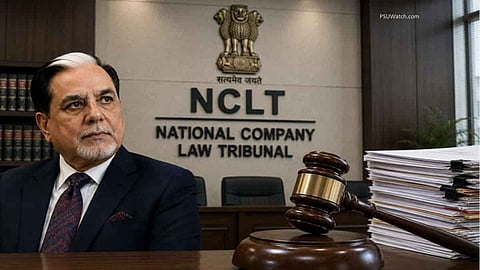
New Delhi: The National Company Law Tribunal (NCLT) has constituted a five-member bench to decide the contentious personal insolvency case of Essel Group Chairman Subhash Chandra, after two members of the tribunal and a third member failed to produce the majority view required to dispose of a repayment plan involving just Rs 6.5 crore against admitted creditor claims of Rs 22,006.57 crore.
The five-member bench, the first of its kind in the NCLT's history, will be headed by President Justice Anupinder Singh Grewal. Bachu Venkat Balaram Das, Mahendra Khandelwal, Atul Chaturvedi and Ravindra Chaturvedi will be the other members.
Follow The PSUWatch Channel on WhatsApp
The bench is scheduled to begin hearing the matter at 10:15 am on Tuesday at the NCLT's Principal Bench.
The move comes after the original division bench failed to arrive at a majority decision even after the matter was referred to a third member. The dispute has now escalated into a larger legal question over whether a repayment plan offering creditors around Rs 6.5 crore can bind lenders that voted against it and extinguish their claims.
The case has been pending for around four years and has pitted dissenting financial institutions against a repayment proposal that offers a fraction of the claims admitted in the insolvency proceedings.
The original division bench comprising Ashok Kumar Bhardwaj, Member (Judicial), and Reena Sinha Puri, Member (Technical), had delivered a split verdict on the repayment plan.
The matter was subsequently referred to a third member. In an order dated August 26, the third member backed the Rs 6.5 crore repayment plan.
Under the procedure, the third member's opinion was sent back to the original division bench for an order in accordance with the majority view, as contemplated under Section 419(5) of the Companies Act, 2013.
That process, however, failed to resolve the matter.
Follow The PSUWatch Channel on WhatsApp
In an order on Monday, Bhardwaj and Puri said the third member had "consciously passed an independent order" and that "no majority view emerges".
The division bench said the technical member had rejected the plan, while the judicial member had confined its approval to creditors who had voted in favour and allowed dissenting banks and financial institutions to pursue recovery separately.
The third member, however, approved the plan while applying Section 115(1) of the Insolvency and Bankruptcy Code uniformly to all creditors, resulting in the extinguishment of the rights of all creditors, including those who had opposed the plan.
"All said and done, no majority view has emerged in the matter," the bench said, concluding that no order could be passed at that stage and referring the matter back to the NCLT President.
The dispute also moved to the National Company Law Appellate Tribunal (NCLAT) on Monday, with dissenting lenders seeking urgent intervention against the effect of the third member's opinion.
Solicitor General Tushar Mehta, appearing for LIC Housing Finance, mentioned the matter before an NCLAT bench headed by Officiating Chairperson Justice Yogesh Khanna. Mehta, who also represented Canara Bank and Union Bank, sought an urgent hearing, arguing that allowing the third member's order to operate could "defeat the very purpose of the Insolvency & Bankruptcy Code".
The appellate tribunal, however, agreed to list the matter for hearing at 10:30 am on Tuesday.
The parallel proceedings underline the significance of the issue for the dissenting lenders, who contend that the proposed recovery is both legally unsustainable and commercially unviable.
At the centre of the litigation is the interpretation of Section 79(2)(g) of the IBC and its interaction with Section 115(1), which governs approval of repayment plans.
In his original order, Bhardwaj had restricted the repayment plan to creditors who voted in its favour, representing around 80.8 percent of creditors. He had allowed the remaining dissenting banks and financial institutions, accounting for roughly 19.2 percent, to independently pursue recovery against Chandra outside the repayment plan.
The third member adopted a fundamentally different approach.
By applying Section 115(1) uniformly, the third member approved the plan while extinguishing the claims of all creditors against the personal guarantor, including those who had opposed the proposal.
The third member also differed from both members of the original bench on the extent to which the adjudicating authority could examine the Section 112 report submitted by the resolution professional regarding the creditors' meetings.
The starkest aspect of the dispute is the gap between the admitted creditor claims and the amount proposed to be paid under the plan.
Dissenting creditors led by LIC Housing Finance had argued that claims of approximately Rs 22,006.57 crore were being sought to be settled through a repayment plan providing Rs 6.25 crore to creditors and Rs 25 lakh towards process costs.
The third member rejected the objections.
The 144-page order relied, among other considerations, on the valuation of Chandra's personal estate, which indicated that his assets were worth significantly less than the amount proposed under the plan.
The order also reasoned that creditors could potentially be worse off if the plan were rejected, as Chandra could instead face bankruptcy, limiting the prospects of recovery.
However, that reasoning does not by itself resolve the central legal dispute over whether creditors that opposed the plan can have their claims extinguished.
The proceedings have generated considerable attention because of the nearly Rs 22,000 crore difference between the admitted claims and the proposed payout. But the numbers need to be viewed in their proper legal context.
The Rs 22,006.57 crore represents creditor claims admitted in the personal insolvency proceedings. The Rs 6.5 crore represents the proposed payment under the repayment plan.
The difference should not be characterised at this stage as a Rs 22,000 crore loan write-off or a crystallised loss for banks. The NCLT has not yet issued a final order resolving the competing views, and the legal treatment of the claims of dissenting creditors remains under adjudication.
Follow PSU Watch on LinkedIN
The five-member bench will now have to address the critical question of whether the repayment plan can legally bind all creditors and extinguish claims of lenders that did not approve it.
The outcome could determine not only the fate of Chandra's personal insolvency proceedings but also how the NCLT interprets the rights of dissenting creditors in personal insolvency repayment plans.
(PSU Watch is India's Business News centre that places the spotlight on PSUs, Bureaucracy, Defence and Public Policy. 👉 Click to join our channel now: PSUWatch WhatsApp Channel. Prefer LinkedIn? Follow PSU Watch on LinkedIN. Click to stay connected on Twitter here and stay updated)

