
- News Updates
- PSU Watch
- Defence News
- Policy Watch
- हिन्दी न्यूज़
- Jobs Watch
- States News
- Event News


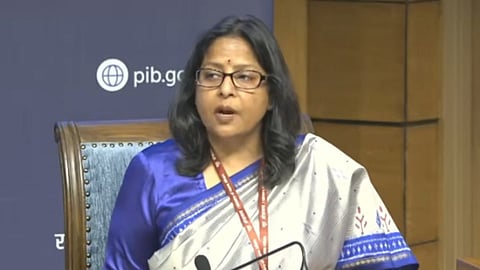
New Delhi: The government has ruled out any immediate financial support for state-run Oil Marketing Companies (OMCs) even as they absorb mounting losses from the West Asia conflict. "Regarding support packages, there is currently no proposal for support to oil marketing companies. Petrol and diesel prices at pumps remain stable," Sujata Sharma, Joint Secretary, Ministry of Petroleum and Natural Gas, said at an inter-ministerial press briefing on Monday.
Follow The PSUWatch Channel on WhatsApp
The statement comes as a government source said that Indian Oil Corporation (IOC), Bharat Petroleum Corporation (BPCL) and Hindustan Petroleum Corporation (HPCL) are collectively losing between Rs 1,000 crore and Rs 1,200 crore every day, with retail prices of petrol and diesel held at two-year-old levels despite a 50 percent surge in crude prices since the West Asia conflict began.
Sharma allayed concerns over supplies, drawing a clear line between financial stress on OMCs and physical availability of fuel. "I want to clearly state once again that we have sufficient stocks — whether crude oil, petrol, diesel, or LPG. Closure of the Strait of Hormuz is perhaps one of the biggest supply disruptions in global market history. Around 20 percent of the world's energy supply passed through there. Many countries, including India, have been affected," she said.
An Inter-ministerial Group of Ministers (IGoM) on the West Asia crisis, which met Monday to take stock of the domestic fuel situation, stated in a post-meeting statement that India currently holds 60 days of crude oil, 60 days of natural gas and 45 days of LPG as rolling stock. There is no shortage of any petroleum product, the statement said.
Sharma laid out the steps taken since the conflict erupted. "India is an import-dependent country. Around 40 percent of our crude and nearly 90 percent of our LPG imports were coming from that region. As soon as the crisis started, the government took several important steps. LPG refineries were immediately instructed to maximize production. LPG for domestic cooking was prioritised. PNG gas was also prioritized for domestic use," she said.
She acknowledged the financial strain on OMCs. "It is true that our companies are buying expensive crude oil from the market and selling it cheaply domestically, putting pressure on their finances. The Prime Minister's appeal yesterday should be seen in this context — how we can conserve energy and use petrol and diesel efficiently to reduce the economic burden on the country," Sharma said.
The briefing was convened a day after Prime Minister Narendra Modi, addressing a BJP rally in Hyderabad on May 10, made an unusually direct appeal to citizens to conserve fuel, defer gold purchases and foreign travel for a year, shift to public transport and carpooling, and move goods by rail rather than road. The speech was framed around the economic disruption caused by the West Asia conflict, which Modi said had severely impacted India's import-heavy energy and fertiliser supply chains.
The appeal rattled equity markets on Monday, with the BSE Sensex tumbling 1,312.91 points or 1.70 percent to 76,015.28 and the NSE Nifty dropping 360.30 points or 1.49 percent to 23,815.85. Analysts said markets read the speech as a signal of deepening macroeconomic stress rather than a routine patriotic call.
Senthil Rajan, Joint Secretary, Ministry of Information and Broadcasting, sought to correct that interpretation at Monday's briefing. "We request all channels to understand the spirit in which the Prime Minister made this appeal. In his Hyderabad speech, the Prime Minister called for collective participation to help India face global economic disruptions, supply-chain challenges, and rising prices caused by international conflict. He emphasised the need for citizens to live responsibly and fulfill duties toward the country during difficult times," he said.
Rajan was explicit that the appeal was not a distress signal. "The idea is optimum and efficient utilisation of available resources. There is no shortage. The Prime Minister's appeal was made in the spirit of efficient resource utilisation," he said.
On Modi's call to avoid foreign travel and gold purchases, Rajan said: "He also appealed to citizens to help conserve foreign exchange reserves by avoiding unnecessary foreign travel, choosing domestic tourism, and celebrating within India. He requested people to avoid non-essential gold purchases for one year in order to reduce pressure on foreign exchange reserves. Every appeal he made was in the context of efficiently utilising resources and minimising economic impact on people."
Follow PSU Watch on LinkedIN
Sharma echoed the PM's message of austerity, framing it as a collective national effort. "Finally, I would like to say that the Hon'ble Prime Minister has appealed to all citizens to reduce petrol and diesel consumption. Wherever possible, use metro and public transport. Choose carpooling. Prefer railways as a mode of transportation for goods. Wherever possible, increase the use of electric vehicles. Let us all together make every effort to conserve energy in our daily usage so that the economic burden on the country can be reduced," she said. She also added that the ministries would chalk out austerity measures and will report it to the media in due course.
(PSU Watch– India's Business News centre that places the spotlight on PSUs, Bureaucracy, Defence and Public Policy is now on Google News. Click here to follow. Also, join PSU Watch Channel in your Telegram. You may also follow us on Twitter here and stay updated.)
