
- News Updates
- PSU Watch
- Defence News
- Policy Watch
- हिन्दी न्यूज़
- Jobs Watch
- States News
- Event News

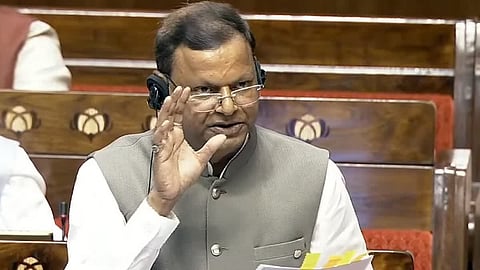
New Delhi: There is no proposal under consideration before the government on the merger or consolidation of public sector banks (PSBs) at present, Minister of State for Finance Pankaj Chaudhary said on Monday.
Chaudhary, in a written reply to the Lok Sabha, said the amalgamation of PSBs helped create stronger competitive banks with economies of scale and scope while enabling the realisation of wide-ranging synergies.
Follow The PSUWatch Channel on WhatsApp
Leveraging networks, better access to low-cost deposits, increased ability to support larger ticket-size lending, and competitive operations by virtue of greater financial capacity have provided the amalgamated banks a substantial rise in customer base, market reach and operational efficiency, he added.
Synergy was also gained due to increased scope of operations and improvement in cost efficiency, with the adoption of best practices and digitisation, he said.
The amalgamation of PSBs, as envisaged, has contributed to improving operational efficiency and financial soundness of banks through streamlining of operations and reduction in costs, thereby resulting in increasing consolidated business of banks, the minister noted.
Quoting Reserve Bank of India data, he said the consolidated total business of Bank of Baroda, in which Vijaya Bank and Dena Bank were amalgamated with effect from April 1, 2019, grew from Rs 16.1 lakh crore in March 2019 to Rs 27.0 lakh crore in March 2025.
Punjab National Bank, in which Oriental Bank of Commerce and United Bank of India were amalgamated with effect from April 1, 2020, grew from Rs 18.3 lakh crore in March 2020 to Rs 26.8 lakh crore in March 2025.
The business of Union Bank of India, in which Andhra Bank and Corporation Bank were amalgamated with effect from April 1, 2020, grew from Rs 15.3 lakh crore in March 2020 to Rs 22.9 lakh crore in March 2025, while Canara Bank, in which Syndicate Bank was amalgamated with effect from April 1, 2020, expanded from Rs 15.7 lakh crore in March 2020 to Rs 25.3 lakh crore in March 2025, he said.
The total business of Indian Bank, in which Allahabad Bank was amalgamated with effect from April 1, 2020, increased from Rs 8.6 lakh crore in March 2020 to Rs 13.3 lakh crore in March 2025, he added.
In reply to another question, Chaudhary said the EASE Reform Agenda is finalised on a yearly basis at the start of each financial year (FY), under the guidance of the EASE Steering Committee of member PSBs under the aegis of the Indian Banks’ Association (IBA).
The reforms agenda is objectively assessed and reviewed quarterly by the EASE Steering Committee, he said, adding that the EASE 9.0 Reforms Agenda for FY2026-27 was launched in February 2026 with a vision of building globally competitive PSBs for Viksit Bharat by 2047.
EASE 9.0 Reforms Agenda is built upon four themes of EASERise framework, i.e. Risk & Resilience, Innovation, Socio-economic Impact and Excellence, he said.
It marks the next phase of reforms aimed at strengthening long-term capabilities of PSBs with a focus on institutionalising customer service culture, artificial intelligence-enabled workflows, strengthening operational risk framework, modernising IT systems, lending to emerging sectors, sustainable finance and employee well-being, he said.
Further, IBA has apprised that metrics of EASE 9.0 Reforms Agenda are under formulation and will be rolled out to PSBs by April 2026, he said.
Replying to another question, Chaudhary said the value of the rupee is market-determined, with no target or specific level or band.
Follow PSU Watch on LinkedIN
The Reserve Bank of India (RBI) regularly monitors the foreign exchange market and intervenes in situations of excess volatility, he said, adding that various domestic and global factors influence the exchange rate of the rupee, such as the movement of the Dollar Index, trend in capital flows, level of interest rates, movement in crude prices, current account deficit, etc.
During the current financial year 2025-26, the depreciation of the rupee has been influenced by the increase in trade deficit amid relatively weak support from the capital account, he said.
Additionally, he said, increasing crude oil prices amid the ongoing conflict in West Asia have added further pressure on the rupee.
During 2024 and 2025, the RBI's intervention in the foreign exchange market was Rs 64,064 crore in two calendar years.
The Reserve Bank sold Rs 12,350 crore and Rs 51,714 crore during 2024 and 2025, respectively, he said.
(PSU Watch– India's Business News centre that places the spotlight on PSUs, Bureaucracy, Defence and Public Policy is now on Google News. Click here to follow. Also, join PSU Watch Channel in your Telegram. You may also follow us on Twitter here and stay updated.)

