
- News Updates
- PSU Watch
- Defence News
- Policy Watch
- हिन्दी न्यूज़
- Jobs Watch
- States News
- Event News


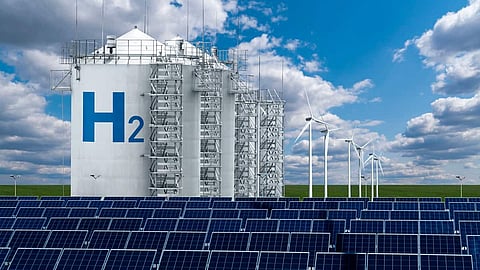
India’s ambition to position itself as a global hub for green hydrogen is steadily taking shape through targeted policy interventions, rising private investment, and growing industrial interest. However, beneath the promise of a clean hydrogen economy lies a less visible yet decisive foundation: critical minerals. From electrolysers and membranes to fuel cells and storage systems, hydrogen technologies depend heavily on a narrow and strategically sensitive set of minerals. Their availability, processing capability and supply chain security will ultimately determine the pace, cost and resilience of India’s hydrogen transition.
Follow The PSUWatch Channel on WhatsApp
Green hydrogen production through electrolysis relies on platinum group metals (PGMs) such as platinum, iridium and ruthenium for catalysts. Membranes and fuel cells depend on fluoropolymers, rare earth elements, nickel, cobalt, graphite and specialised alloys. Consequently, the scalability and affordability of hydrogen infrastructure are inseparable from assured access to processed critical minerals, not merely geological availability. Countries that command refining and purification capabilities, rather than just raw resources, enjoy a decisive strategic advantage.
Globally, hydrogen is emerging as a strategic energy carrier for hard-to-abate sectors, such as steel, cement, fertilisers, long-haul transport and shipping. Leading economies are simultaneously investing in hydrogen capacity and securing downstream mineral supply chains. The key global learning is clear: control over processing and refining matters more than ownership of ore bodies. Refined materials ultimately dictate industrial competitiveness, project economics, and speed of deployment, placing mineral processing at the centre of the global hydrogen race.
Aligning hydrogen hubs with mineral processing clusters can significantly improve project viability, reduce supply chain risk and enhance investor confidence
India has responded with a coordinated policy framework that explicitly links clean energy transition with mineral security. The National Green Hydrogen Mission (NGHM), approved in 2023 with an outlay of Rs 19,714 crore, and the National Critical Mineral Mission (NCMM), launched in 2025 with an allocation of Rs 16,300 crore, together represent a combined public commitment exceeding Rs 36,000 crore. These missions aim to promote domestic electrolyser manufacturing, develop hydrogen hubs, accelerate mineral exploration and scale recycling, while simultaneously strengthening industrial resilience and strategic autonomy.
Significant progress is already evident. Approximately 0.86 million tonnes per annum (MMTPA) of green hydrogen production capacity has been allocated across 19 public and private entities, with an explicit national objective of capturing around 10 percent of global green hydrogen demand by 2030. Parallel reforms in mineral auctions, royalty rationalisation for 12 critical minerals and exploration incentives signal a decisive move towards unlocking private capital.
While the policy intent is robust, accelerated execution is essential. Priority actions include faster environmental clearances, long-term offtake assurances, viability gap funding for early-stage projects and integrated planning of power, water, logistics and port infrastructure. Aligning hydrogen hubs with mineral processing clusters can significantly improve project viability, reduce supply chain risk and enhance investor confidence.
Large-scale deployment of hydrogen and mineral processing infrastructure is impossible without strong private participation
Large-scale deployment of hydrogen and mineral processing infrastructure is impossible without strong private participation. Encouraging commitments from major Indian conglomerates across hydrogen production, electrolyser manufacturing and critical mineral processing reflect growing confidence in policy direction. Stable regulations, predictable revenue frameworks and risk-sharing mechanisms will be critical to translating announcements into operating assets and sustaining investment momentum.
Advanced satellite-based multispectral and hyperspectral remote sensing provides a powerful tool to fast-track exploration of both critical minerals and natural hydrogen. Although hydrogen lacks a direct spectral signature, its micro-seepage alters surface mineralogy, oxidation states, carbonate precipitation, vegetation stress and geochemical patterns that can be detected remotely. Integrating these datasets with geophysical and geochemical surveys can substantially reduce exploration time and cost, provided field validation mechanisms are strengthened in parallel.
Globally, circular vegetation anomalies, commonly referred to as “fairy circles,” are being investigated as potential surface expressions of subsurface hydrogen leakage. In India, such features are not yet confirmed as hydrogen indicators. However, analogous geological settings, including ultramafic belts, deep-seated fault systems, ophiolite complexes, fold belts and cratonic regions, warrant systematic investigation. Given that natural hydrogen is potentially renewable and carbon-free, focussed scientific and policy attention to its exploration could be both timely and strategically justified.
In the near term, importing mineral concentrates for domestic refining can help build scale, skills and technological capability, while indigenous mining ramps up
India’s most critical vulnerability lies in limited domestic processing and refining capacity. Dedicated incentives for environmentally compliant plants, assured feedstock linkages and access to low-cost finance are essential to move up the value chain. In the near term, importing mineral concentrates for domestic refining can help build scale, skills and technological capability, while indigenous mining ramps up.
Urban mining through e-waste and spent lithium-ion batteries presents a complementary opportunity. India generates approximately 1.75 million tonnes of e-waste annually, including nearly 60 kilotonnes of spent lithium-ion batteries. Advanced recycling can recover lithium, cobalt, nickel and rare earths at significantly lower energy and environmental cost than primary mining. The Rs 1,500-crore incentive scheme under NCMM for secondary resource recovery is a positive step, though challenges remain in formalising collection networks, integrating the informal sector and mobilising large-scale capital investment.
Follow PSU Watch on LinkedIN
India’s hydrogen ambition cannot be realised in isolation from its critical minerals strategy. Exploration, processing, recycling, infrastructure development and private participation must progress in tandem. Strategic deployment of remote sensing, targeted policy refinements, and circular economy principles can position India as a global hub for green hydrogen and critical mineral processing, strengthening energy security, industrial competitiveness and climate leadership in the decades ahead.
Disclaimer: This is an Op-ed article. The opinions expressed in this article are the author's own. PSU Watch does not endorse nor support views, opinions or conclusions drawn in this post and we are not responsible or liable for any content within the article or for any damage or loss caused by and in connection to it.
(PSU Watch– India's Business News centre that places the spotlight on PSUs, Bureaucracy, Defence and Public Policy is now on Google News. Click here to follow. Also, join PSU Watch Channel in your Telegram. You may also follow us on Twitter here and stay updated.)
