
- News Updates
- PSU Watch
- Defence News
- Policy Watch
- हिन्दी न्यूज़
- Jobs Watch
- States News
- Event News


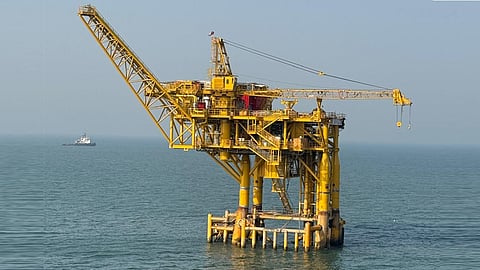
India’s hydrocarbon future increasingly looks offshore, particularly to the deep and ultra-deep waters of its sedimentary basins, which remain among the least explored in the world. The government has continuously undertaken policy reforms over the past decades to make exploration more attractive. Yet the central question persists:
“Can the proposed Samudra Manthan initiative kickstart the exploration of India’s vast offshore frontier on a meaningful risk-sharing basis?”
Follow The PSUWatch Channel on WhatsApp
The name evokes the mythological churning of the ocean for hidden treasure. From a policy perspective, the initiative seeks to unlock geological potential through improved regulatory frameworks, collaborative exploration models, and better data availability. Yet, unless structural deterrents are addressed, its push towards risk-sharing will remain more symbolic than transformational.
India has nearly 3.36 million sq km of sedimentary basins. Of these, 1.73 million sq km lie offshore, and a significant 1.32 million sq km fall in deepwater areas. However, exploration intensity remains low compared with global benchmarks.
Most offshore discoveries so far have been confined to the Western Offshore (Mumbai High and the surrounding basins), the Krishna-Godavari (KG) Basin, and the Cauvery Basin. Large parts of the Andaman-Nicobar deepwater region, the eastern offshore beyond Krishna-Godavari, and ultra-deepwater areas deeper than 2,000-3,000 metres remain sparsely drilled. Even in the Andaman-Nicobar Basin, current exploration is confined mainly to shallow waters.
Oil India Limited’s (OIL) recent gas discovery in its ongoing exploration points firmly to the next step. Its data and findings should be fed back into the database, followed by sustained drilling extended to the deeper part of the basin. That would build a robust database for basin modelling studies to locate the major gas fields awaiting discovery.
India’s eastern offshore flanks some of the world’s most prolific offshore oil and gas provinces, yet exploration on the Indian side remains very limited.
Across the maritime boundary in the Bay of Bengal, operators in Myanmar and Southeast Asia have successfully developed deepwater gas discoveries in similar geological settings. Yet many of these same international operators show little interest in India’s Open Acreage Licensing Policy (OALP) rounds.
This reluctance raises a critical question: “Does the problem lie in complex and uncertain geological settings, or in policy risks?”
Over the past two decades, India has reformed its exploration framework in stages. The New Exploration Licensing Policy (NELP) introduced competitive bidding to encourage private and foreign operators to participate. The Hydrocarbon Exploration and Licensing Policy (HELP) then shifted the regime to revenue sharing under a uniform licensing framework. HELP was later reformed so that companies can identify exploration areas round the year and propose blocks for bidding based on available geological data. In addition, the National Data Repository (NDR) will give prospective bidders access to exploration data.
The Samudra Manthan initiative appears set to give offshore exploration much-needed momentum by combining geoscientific data generation, better licensing mechanisms, and, potentially, government-supported risk-sharing exploration.
However, policy reforms alone have not so far translated into strong participation by major international operators. The prime concern that bothers us at this stage is: “What is stopping investors from participating?”
Even after several policy reforms, structural concerns continue to shape investor perception. Some of the possible concerns are set out below.
Uncertainty over revenue sharing
One perceived deterrent is that under HELP’s revenue-sharing framework, companies must commit a share of revenue irrespective of profitability. This introduces significant commercial uncertainty.
In deepwater exploration, the risk is higher still. Discovery risk is high, development costs after a discovery are extremely large, and projects take significantly longer to complete.
Complex regulation
Despite improvements, operators still face multi-layered approvals from agencies dealing with environmental clearance, coastal regulation, defence permissions, maritime navigation, and fisheries.
The absence of a fully operational single-window clearance system continues to delay exploration programmes. Even when discoveries occur, regulatory processes have been seen to stretch development timelines significantly.
Curbs on selling what is produced
Investors also remain cautious because of perceived constraints on marketing freedom, pricing mechanisms, gas allocation priorities, and export flexibility.
It is encouraging that reforms have gradually liberalised gas marketing and pricing for difficult fields to help bridge the gap. But winning investors’ confidence requires long-term policy stability rather than periodic exemptions.
Risk sharing, the missing ingredient
Exploration, by its very nature, involves deploying high-risk capital. In frontier offshore basins, where the success ratio is one in every 15 wells drilled, a sustained, government-funded early exploration phase has become the only panacea. Globally, governments encourage deep and ultra-deepwater exploration by participating actively in the early phase. They do so through state-funded seismic acquisition, stratigraphic drilling programmes, tax credits for exploration wells, cost-sharing mechanisms, and risk service contracts.
The most encouraging fact is that most of these measures have been taken up in recent times, the latest being the Cabinet approval of an outlay of Rs 84,084 crore for Samudra Manthan. Nevertheless, if Samudra Manthan aims to stimulate deepwater exploration, it may need to move beyond policy rhetoric into a structured national exploration programme, in which the state shares geological risk rather than transferring it entirely to investors.
A recurring pattern in India’s exploration landscape is the expectation that foreign companies will participate once major discoveries are made. However, large discoveries rarely emerge without sustained early exploration.
In many successful offshore provinces, including Brazil’s pre-salt, the Gulf of Mexico, and West Africa, the initial breakthroughs came only after government-supported frontier exploration programmes, followed by mega-scale international participation. Expecting major discoveries to precede investment therefore reverses the natural sequence of exploration economics.
Given the lack of interest from foreign investors, there is a worry that India’s deepwater may be non-prospective. However, there is no geological basis to assume that India’s deep and ultra-deepwater basins lack hydrocarbon potential. The proven petroleum systems in the Krishna-Godavari and Cauvery basins, geology analogous to Myanmar’s productive offshore basins, thick sedimentary sequences, indications of deep turbidite systems, and evidence of gas hydrate and thermogenic gas systems all suggest that extensive, sustained exploration is the call of the hour.
The challenge, then, may be insufficient drilling density and limited high-resolution geophysical data on how far these geological settings extend. Without drilling, no basin can be declared non-prospective.
Some essential additions to offshore exploration are already in place. These include ongoing government-led frontier exploration through stratigraphic wells, and the fiscal incentives offered in the OALP-XI round: exploration tax credits, a lower government take during early production, and an extended exploration period. However, for Samudra Manthan to truly unlock offshore potential, several more elements may be necessary.
Government-led frontier exploration
Sustained government-led exploration, with more stratigraphic and scientific drilling in deepwater basins, particularly in the Andaman region, could significantly de-risk future licensing rounds.
Drawing on the experience of the OALP-XI round, revisiting the fiscal regime to launch a special regime for ultra-deepwater and frontier basins would be a prudent step. It would keep the exploration venture going until India’s success in these basins is tested.
The recent changes in royalty for oil and gas fields under the nomination regime will definitely provide much-needed financial strength to state-owned companies such as Oil and Natural Gas Corporation (ONGC) and Oil India. This will support aggressive and sustained exploration in India’s hitherto unexplored and underexplored Category II and III basins. The latest encouraging step is the Cabinet approval of the Rs 84,084 crore outlay for Samudra Manthan.
A stable marketing and pricing framework
Clear, long-term assurance of market-linked pricing and marketing freedom would strengthen investor confidence.
A true single-window clearance
Integrating all regulatory approvals on a digital single-window platform with defined timelines could substantially reduce operational uncertainty.
Strategic global partnerships
Greater participation by large international operators through targeted exploration partnerships may help accelerate learning and technology transfer.
The metaphor of Samudra Manthan suggests a collective churning of the ocean to uncover hidden wealth. For India’s offshore sector, that wealth lies not merely beneath the seabed but in the policy architecture governing exploration.
If the initiative evolves into a true risk-sharing national exploration programme, supported by fiscal stability, regulatory clarity, and strategic partnerships, it could mark a turning point for India’s offshore hydrocarbon sector.
But if private operators are still expected to bear almost all the exploration risk under uncertain regulatory conditions, the country may keep waiting for discoveries that need the very investment current policies struggle to attract.
Follow Energy Watch on LinkedIN
India’s offshore basins remain among the world’s least explored petroleum frontiers. The real question is not whether hydrocarbons exist beneath these waters, but whether the exploration framework is ready to discover them.
Disclaimer: This is an Op-ed article. The opinions expressed in this article are the author's own. PSU Watch does not endorse nor support views, opinions or conclusions drawn in this post and we are not responsible or liable for any content within the article or for any damage or loss caused by and in connection to it.
(PSU Watch– India's Business News centre that places the spotlight on PSUs, Bureaucracy, Defence and Public Policy is now on Google News. Click here to follow. Also, join PSU Watch Channel in your Telegram. You may also follow us on Twitter here and stay updated.)
