
- News Updates
- PSU Watch
- Defence News
- Policy Watch
- हिन्दी न्यूज़
- Jobs Watch
- States News
- Event News

Thiruvananthapuram: The Kerala government's fiscal status report has called for a sweeping restructuring of the KIIFB, arguing that the institution has outlived its original purpose and evolved into a parallel fiscal authority whose debt obligations now fall squarely on the state government.
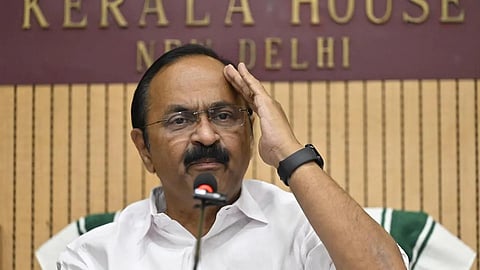
The white paper, tabled in the Assembly by Chief Minister V D Satheesan on Thursday, says Kerala Infrastructure Investment Fund Board currently has loan liabilities of around Rs 21,000 crore while projects worth another Rs 35,000 crore remain to be funded, leaving Kerala with a combined obligation of roughly Rs 56,000 crore.
Follow The PSUWatch Channel on WhatsApp
The report was prepared by a three-member committee headed by former Cabinet Secretary K M Chandrasekhar.
According to it, Kerala's fiscal stress was aggravated by the creation of KIIFB as a large autonomous borrowing entity operating outside the normal budgetary framework.
Established to accelerate infrastructure development by bypassing the state's borrowing limits, KIIFB gradually evolved into what the report describes as a "parallel fiscal authority".
The white paper pointed out that KIIFB effectively became "a second government with its own borrowing programme, its own project pipeline, and its own debt service obligations", but without the revenue streams, legislative oversight, accountability mechanisms and expenditure controls applicable to the state budget.
"The consequences for fiscal management are serious," the white paper says, arguing that the arrangement weakened fiscal discipline while creating liabilities that ultimately fell on the state treasury.
It notes that dedicated revenue streams such as petroleum cess and a share of Motor Vehicle Tax were earmarked for KIIFB. The white paper says 50 percent of Motor Vehicle Tax revenue continues to be diverted to the institution, amounting to Rs 3,300 crore in 2025-26 alone.
The white paper argues that such diversion of revenue has reduced the state government's fiscal flexibility at a time of mounting financial pressure.
It further recommends amendments to the KIIFB Act, arguing that the institution cannot continue under its existing legal framework once its borrowings are treated as state borrowings. At the same time, the white paper advises against dismantling KIIFB altogether.
It notes that over nine years the institution has built significant expertise in project appraisal, technical inspection, climate-resilient infrastructure, sustainability standards and digital project management.
"It would be wasteful to dismantle this," it says, recommending that KIIFB's technical and organisational capacities be absorbed into government departments.
It has recommended ending KIIFB's independent borrowing model and bringing its financing operations under closer government control.
It says KIIFB should no longer be permitted to borrow independently from external sources. Instead, the Finance Department should raise funds at lower rates and channel them to KIIFB to meet its obligations.
"It is not prudent to continue diverting state revenue into an escrow account," the white paper says.
It also recommends a forensic audit of KIIFB's accounts, including expenditure related to the Masala Bond issue, consultancy payments and instances where borrowed funds were deposited back with banks, allegedly leading to avoidable costs.
"The question is no longer whether KIIFB should continue in its current form," it says.
"The question is how to manage the transition: honouring committed liabilities, retaining institutional capacity, amending the legal framework, and ensuring that the costs accumulated are transparently accounted for and prudently managed in the years ahead," the white paper adds.
According to the white paper, the Comptroller and Auditor General (C&AG) has already concluded that KIIFB lacks an adequate independent revenue base and that its debt should effectively be treated as state debt.
"KIIFB was a bold institutional innovation and was an attempt to create a professionally managed, market-facing infrastructure financier that could bypass the fiscal constraints binding the state budget," it says.
"Its borrowings are now state borrowings. Its financing costs are consistently higher than government borrowing rates," the white paper finds.
It says KIIFB received total inflows of Rs 74,171 crore as of March 31, 2026. This included government contributions of Rs 26,497 crore, borrowings of Rs 42,053 crore, project repayments of Rs 3,700 crore and other income of Rs 1,920 crore.
Follow PSU Watch on LinkedIN
Of the Rs 42,053 crore borrowed, less than Rs 10,000 crore has been repaid. The white paper noted that finance costs alone have reached Rs 10,198 crore, almost equal to the principal repaid.
It estimates the remaining fund balance with KIIFB at around Rs 11,000 crore, leaving an unmet loan liability of roughly Rs 21,000 crore.
(PSU Watch is India's Business News centre that places the spotlight on PSUs, Bureaucracy, Defence and Public Policy. 👉 Click to join our channel now: PSUWatch WhatsApp Channel. Prefer LinkedIn? Follow PSU Watch on LinkedIN. Click to stay connected on Twitter here and stay updated.)

