
- News Updates
- PSU Watch
- Defence News
- Policy Watch
- हिन्दी न्यूज़
- Jobs Watch
- States News
- Event News


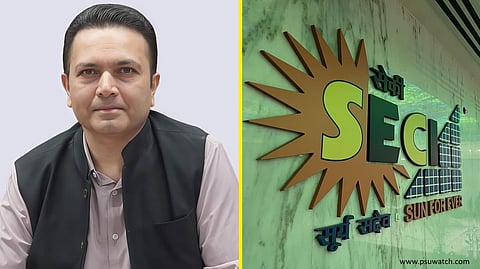
New Delhi: Solar Energy Corporation of India Limited (SECI) is recalibrating its Renewable Energy (RE) bidding strategy as India’s power system enters a new phase marked by rising solar deployment, pending Power sale Agreements (PSAs) and growing demand for peak power. SECI’s Managing Director Akash Tripathi (IAS) said in an exclusive interview with PSU Watch that the agency is increasingly focusing on storage-backed configurations such as firm and dispatchable renewable energy (FDRE), round-the-clock (RTC) power and peak supply projects to address intermittency and grid integration challenges.
Here are edited excerpts:
Follow The PSUWatch Channel on WhatsApp
SECI has been a fulcrum in India’s renewable energy journey — from discovering tariffs to becoming a power trader and now developing projects. How do you see SECI’s role evolving?
SECI has been at the forefront of RE development in the country. We have been a market maker and have discovered the lowest tariffs depending on the evolution of renewable energy in India. So far, we have issued Letters of Award (LoAs) for close to 75 GW of capacity across different configurations — wind, solar, hybrid, solar with battery energy storage systems and FDRE projects. We have signed about 63 GW of PSAs with DISCOMs and corresponding PPAs with developers. Deployment so far is around 36 GW and SECI accounts for roughly 15 percent of India’s renewable energy capacity.
It has been a remarkable journey in terms of tariffs as well. Earlier tariffs were in the range of Rs 8–10 per unit. Now they are in the range of Rs 2–3 per unit.
But as RE capacity grows and more than half of new additions are non-fossil, the challenge of variability and intermittency has become more prominent. There is also curtailment due to grid congestion. To address this, we have moved towards FDRE, RTC and peak power configurations.
And similarly, we are also working on green molecules. We have recently discovered record low prices for green ammonia, which is globally the lowest rate discovered so far — Rs 49.75 per kg. It will be supplied to least 13 fertilizer companies. We now await the signing of the purchase and sale agreement, which should be done by April. Also, we are currently discussing the requirement of green methanol for the maritime sector. We might float a bid for almost 5,00,000 tonnes of green methanol.
In addition, to address the supply chain-related challenges with batteries, we are also working on PSPs (Pumped Storage Projects). We have come out with a PSP long-duration storage tender. It is for 1,000 MW but we might increase the capacity if we get more interest from states. We plan to close the bid by March-end or so.
The rise in RE curtailment points to the need for storage. What happens to existing solar and wind projects that are already commissioned?
Follow PSU Watch on LinkedIN
The CERC has amended the General Network Access regulations. According to this, RE developers will have to secure connectivity for non-solar hours as well. That means they will have to supply power beyond solar hours, which can be achieved through storage.
For commissioned projects with PPAs already signed, we are exploring models to enable battery deployment. That would benefit DISCOMs because they will get peak power as well. SECI is working on aggregation models to facilitate this.
SECI discovered record-low prices for green ammonia. Why have we not seen more tenders since then?
That was always the plan. Green ammonia supply under this tender will begin around 2029. For now, we want to demonstrate viability at the discovered price of Rs 49.75 per kg. Depending on how grey ammonia prices evolve, exchange rate movements and the geopolitical situation, additional demand may emerge.
The fertiliser sector alone consumes about 20 million tonnes of grey ammonia annually. This tender is only for about 0.724 million tonnes. So, the potential is very large. If the economics improve and the first contracts are implemented successfully, we can scale up significantly.
SECI is now developing projects on a capex basis, including in strategic locations. Is this a decisive shift?
We have worked on the concept of greening islands, such as, Andaman and Nicobar and Lakshadweep. We prepared feasibility reports and action plans and submitted them to the Ministry of Home Affairs and the island administrations. The idea is to reduce dependence on diesel-based power generation in these islands. Some projects have already been entrusted to SECI and we are working on them.
However, we are also developing projects in established renewable zones such as Andhra Pradesh, Gujarat, Rajasthan and Madhya Pradesh. Floating solar is another area of interest. We are in discussions with the Odisha government for 300–400 MW of floating solar in their reservoirs.
What is the status of SECI’s planned IPO?
We have submitted our proposal and DIPAM is examining it. We hope it will materialise in 2026–27.
SECI has aggressively tendered capacity in recent years, but absorption by DISCOMs has not always kept pace. Is there a case for slowing down bidding?
Yes. Distributed RE has grown significantly through PM Surya Ghar, PM-KUSUM and rooftop solar programmes. Similarly, the commercial and industrial segment has seen strong growth. Roughly 40–50 percent of RE additions now come from these segments.
Because of this, RE implementation agencies also need to recalibrate their tendering strategy. There are several LoAs that are still pending conversion into PSAs. This year SECI has issued tenders for around 5.5 GW, out of which PPAs have been signed for about 4.5 GW. We currently have an inventory of around 8 GW and we are hopeful of signing close to 6.5 GW of PPAs by FY26-end.
Earlier we used to issue tenders based on a capacity target. Now we are consulting DISCOMs and states and issuing tenders based on their demand.
Transmission constraints are also cited as a challenge. How do you see that evolving?
Transmission planning needs to be ahead of RE deployment. This has been discussed regularly with the Ministry of Power. In the national transmission plan, the government is already planning beyond 2030 so that the network is ready.
As the ISTS waiver tapers, many states are also strengthening their own intra-state transmission systems. Therefore, in our tenders we are giving flexibility for projects to be either ISTS-connected or connected through state transmission utilities.
Why did offshore wind tenders fail to attract bids earlier?
The main challenge has been supply chain constraints. Developers were not confident about executing the projects within time and cost. We have now modified our strategy. Earlier we offered 500 MW each off Gujarat and Tamil Nadu. Now we will allow the entire 1 GW capacity to be developed along one coast so that economies of scale can be achieved.
India has also launched a partnership platform with the UK, which has extensive offshore wind experience. Through this we expect collaborations with global companies and development of the required ecosystem.
What progress has been made under the National Green Hydrogen Mission?
For electrolyser manufacturing, we have awarded projects for about 3,000 MW capacity. For green hydrogen production we have awarded tenders for around 8,62,000 tonnes. Some projects are facing challenges in reaching final investment decisions, largely because of offtake uncertainties and regulatory developments such as the EU’s RFNBO rules.
However, some Indian companies have signed international offtake agreements. If that trend continues, the projects should move forward.
What trends will shape India’s renewable energy expansion over the next few years?
India has a target of 500 GW of non-fossil capacity by 2030 and we are confident of achieving it. However, we need to focus strongly on energy storage. The Energy Storage Obligation has already been notified and states will have to comply with it.
Every state needs peak power and that can only come through storage. By 2030, India may require close to 40 GW of storage capacity to manage intermittency and variability in RE generation.
If we can deploy that level of storage, the grid will become far more resilient and greener, and RE will remain cost-effective.
(PSU Watch– India's Business News centre that places the spotlight on PSUs, Bureaucracy, Defence and Public Policy is now on Google News. Click here to follow. Also, join PSU Watch Channel in your Telegram. You may also follow us on Twitter here and stay updated.)
