
- News Updates
- PSU Watch
- Defence News
- Policy Watch
- हिन्दी न्यूज़
- Jobs Watch
- States News
- Event News

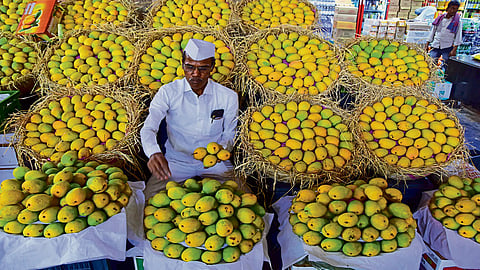
New Delhi: Mango growers of Uttar Pradesh have raised concern over the Nepal government's decision to ban Indian mango imports, saying the move would affect the Indian fruit's image globally, even as the state government sees little impact on farmers' earnings.
Nepal authorities have prohibited the import of mangoes from India, citing the use of excessive pesticides and a lack of quarantine facilities in the border areas, mainly the Madhesh province.
Follow The PSUWatch Channel on WhatsApp
The move came days after Japan suspended imports of fresh mangoes from India for the current season, halting shipments of several Indian mango varieties to Japan.
According to farmers in Malihabad, on the outskirts of Lucknow, the Nepal government's move could affect the image of the Indian fruit adversely in the international markets.
Malihabad is one of India's best-known mango-producing regions, and is particularly famous for its Dasheri variety, which is exported to domestic and overseas markets.
Local growers said the decision has come at a time when farmers are already struggling to get remunerative prices for their produce.
Kaleem Ahmad, a mango farmer, said the ban could also have an impact on the domestic market. "Whenever mangoes are exported, both farmers and the government benefit. Such decisions increase the difficulties faced by growers."
Ahmad also suggested that Nepal's move could be aimed at promoting its own domestic produce and protecting its local market.
"Farmers are already battling rising input costs and low returns. Any adverse impact on exports will only add to their problems," he said.
Another grower, Mohammad Ikraar, said the decision could affect the credibility of Indian mangoes abroad.
"We nurture mango orchards like our own children, but even then, farmers are not getting prices commensurate with their hard work. Any hurdle in exports becomes a matter of concern," he said.
Dinesh Pratap Singh, Agricultural Marketing, Foreign Trade and Exports Minister, said Nepal is a sovereign nation and issues concerning trade between two countries are dealt with by the Centre.
"Our farmers work hard to produce quality mangoes and supply them across the country and abroad," Singh said.
The minister said he had recently visited Moscow, where he personally served Indian mangoes to around 600 Russian citizens, underscoring the popularity of Indian mangoes in global markets.
"Many countries across the world appreciate Indian mangoes. Why Nepal has taken such a decision is beyond my understanding," he said.
Singh further said that growers in several orchards use protective bagging techniques at an early stage of fruit development to ensure that mangoes are not affected by chemicals or pesticides.
"There may be some mangoes that are not bagged, but it is not appropriate to defame all mangoes of the state because of a few complaints," he said.
The minister also said that Nepal's consumption of mangoes was relatively small compared to Uttar Pradesh's production and domestic demand.
"The quantity of mangoes consumed in Nepal is not even equal to the consumption of a single district in Uttar Pradesh. Therefore, the ban will not have any major impact on our farmers. However, the reputation and honour associated with Indian mangoes have certainly been hurt," he said.
Appealing to Nepal to review its decision, Singh said that if there were complaints regarding the quality of some consignments, those specific cases could have been examined separately instead of imposing a blanket ban.
Follow PSU Watch on LinkedIN
"I am saddened by Nepal's decision and hope the Nepal government reconsiders the matter," he added.
India is the world's largest producer of mangoes, with an annual output of over 26 million metric tonnes and more than 1,000 named varieties.
Major importers of Indian mangoes include the US, the UAE, the UK, the Netherlands and Saudi Arabia.
(PSU Watch is India's Business News centre that places the spotlight on PSUs, Bureaucracy, Defence and Public Policy. 👉 Click to join our channel now: PSUWatch WhatsApp Channel. Prefer LinkedIn? Follow PSU Watch on LinkedIN. Click to stay connected on Twitter here and stay updated)

