
- News Updates
- PSU Watch
- Defence News
- Policy Watch
- हिन्दी न्यूज़
- Jobs Watch
- States News
- Event News

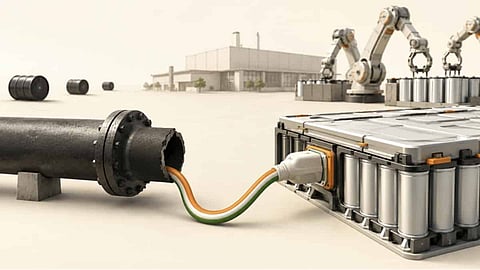
New Delhi: India could reduce its annual import bill for road-transport fuel and electric-vehicle batteries by as much as USD 125 billion by 2050 if it rapidly electrifies all major vehicle segments and builds substantial battery-manufacturing capacity at home, according to a study by the International Council on Clean Transportation (ICCT).
The estimate is based on the study’s most ambitious scenario and should not be read as a forecast. The eventual savings would depend on the pace of EV adoption, future oil and battery prices, vehicle demand and the extent to which battery-cell production is localised.
Titled India’s EV Transition: Impact of Electric Vehicle Battery Demand on Import Payments from 2024 to 2050, the study examines whether India’s growing requirement for imported batteries could offset the foreign-exchange savings generated by lower petrol and diesel consumption.
Follow The PSUWatch Channel on WhatsApp
Its central finding is that the potential reduction in oil imports would substantially exceed the additional cost of importing batteries.
“The money India can save by importing less petrol and diesel outweighs the cost of importing batteries by an order of magnitude,” the study said.
The ICCT model covers two-wheelers, three-wheelers, passenger cars, light commercial vehicles, buses and trucks between 2024 and 2050. It assesses three EV-adoption pathways—baseline, momentum and ambitious—against four possible levels of domestic battery production.
The battery-manufacturing scenarios range from no localisation and slow localisation to production based on announced capacity and a high-localisation pathway.
Under all three EV-adoption pathways, battery demand is projected to rise sharply after 2030. By 2050, annual demand could reach about 340 gigawatt-hours under the baseline pathway and around 573 gigawatt-hours under the momentum and ambitious pathways.
The study estimates that faster electrification alone could reduce India’s vehicle-related import bill by about 61 percent by 2050, even if the country continued to rely on imported batteries. In that scenario, annual imports would fall from an estimated USD 153 billion to USD 59 billion—a saving of about USD 94 billion.
The potential reduction rises to 82 percent, or approximately USD 125 billion annually, when accelerated EV adoption is combined with rapid localisation of battery-cell manufacturing.
“Every electric vehicle India puts on the road reduces its dependence on imported oil, whether the batteries are manufactured domestically or imported,” ICCT researcher and study co-author Namita Singh said.
“Accelerated EV adoption alone could cut India’s road-transport import bill by 61 percent by 2050. Coupling rapid adoption with domestic battery manufacturing could raise those savings to 82 percent,” she added.
ICCT India Managing Director Amit Bhatt said faster electrification would also reduce India’s vulnerability to volatility in international crude-oil prices.
Follow PSU Watch on LinkedIN
“The faster India electrifies, the less exposed it is to global crude price shocks, and the stronger its case for ‘Aatmanirbhar Bharat’,” Bhatt said.
“Localising battery manufacturing adds real value on top, but the pace of the transition is what protects India first,” he added.
The study effectively separates two policy objectives that are often treated as inseparable. Domestic battery manufacturing would improve the trade benefits of electrification, but the analysis suggests India would still record substantial net import savings even if battery localisation progressed slowly.
(PSU Watch is India's Business News centre that places the spotlight on PSUs, Bureaucracy, Defence and Public Policy. 👉 Click to join our channel now: PSUWatch WhatsApp Channel. Prefer LinkedIn? Follow PSU Watch on LinkedIN. Click to stay connected on Twitter here and stay updated)

