
- News Updates
- PSU Watch
- Defence News
- Policy Watch
- हिन्दी न्यूज़
- Jobs Watch
- States News
- Event News

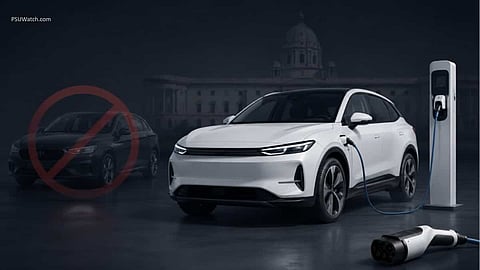
New Delhi: Automobile manufacturers with large portfolios of petrol and diesel vehicles could face growing regulatory pressure as the government considers tighter restrictions on internal combustion engine (ICE) vehicles and taxation changes aimed at accelerating India’s transition to electric mobility.
Addressing the 66th Annual Convention of the Society of Indian Automobile Manufacturers (SIAM) on Thursday, Adviser to the Prime Minister Tarun Kapoor said the industry should prepare for a “major transition” over the next five years rather than expect incremental policy changes.
“In Delhi and this region, already restrictions have started coming in. Other areas also they may start kicking in. So therefore, we have to prepare for that,” Kapoor said.
Follow The PSUWatch Channel on WhatsApp
His remarks represent a clear policy signal, but not a formal nationwide announcement. Kapoor did not specify the nature, geographical scope or timeline of the proposed restrictions.
Delhi’s EV Policy 2026 has already laid down phased electrification requirements for some vehicle categories. It provides for permitting only electric N1 goods carriers for new registrations from January 2027 and only electric two-wheelers from April 2028. Kapoor indicated that similar measures could eventually be considered elsewhere. Business Today
“On the four-wheeler side, I can tell you that more and more restrictions will come. Therefore, please be prepared, and we need to push electric in a big way,” he told automobile manufacturers.
Kapoor also signalled potentially significant taxation changes, including measures affecting imported batteries as domestic manufacturing capacity expands.
“On the taxation front, there are certain issues to be sorted out because people keep meeting me about the import of batteries and whether, as more manufacturing is now happening in India, we can put some restrictions there,” he said.
The statement suggests that the government is examining a combination of tax incentives and import barriers to encourage local battery production. However, Kapoor did not disclose whether the proposed intervention would involve higher customs duties, changes in GST or another fiscal mechanism.
“So please expect some major things to come from our side, and the industry has to be prepared for that,” he said.
While such measures could support domestic cell and battery manufacturing, import restrictions imposed before adequate local capacity is available could raise input costs for electric vehicle manufacturers and, ultimately, consumers. Kapoor acknowledged that manufacturing costs remained high and said the government and industry needed to explore ways to make EVs more affordable.
He identified financing models, battery swapping and wider charging availability along highways as possible solutions. The transition, however, continues to face a basic infrastructure problem: many chargers installed by oil marketing companies are not functioning because low utilisation has discouraged adequate maintenance, Kapoor said.
He called for professional charging-network operators to enter the market and ensure that installed infrastructure remains operational.
Heavy commercial vehicles emerged as another major focus of Kapoor’s address. He described diesel consumption as a significant energy-security concern and argued that the industry must move beyond small electric-truck pilots.
Kapoor said proposals involving 200 or 500 electric trucks would not be sufficient and called for volumes to increase several times over. Large fleet operators in sectors such as coal and mining could help create the initial demand needed to scale up the market, he added.
The push is being driven partly by India’s continued dependence on imported crude oil and liquefied natural gas. Kapoor said the country could not substantially improve energy security if diesel demand remained elevated even as petrol consumption declined.
India’s mobility transition should therefore cover not only passenger vehicles but also trucks and other heavy vehicles, he said. CNG had helped begin the shift towards cleaner fuels, but the next phase would require a much larger move towards electrification.
Kapoor also urged manufacturers to localise critical components, invest in research and design, and reduce dependence on imported technologies and materials. India, he said, should aim to become a global hub for advanced mobility technology and manufacturing rather than remain merely an assembly base.
Follow PSU Watch on Linked
The remarks put automobile companies on notice that the government’s EV strategy could increasingly rely on regulatory restrictions and tax measures, alongside subsidies and production incentives. But the absence of a defined national roadmap, implementation schedule and clarity on charging infrastructure means the industry has been warned to prepare for changes whose precise contours are yet to be disclosed.
(PSU Watch is India's Business News centre that places the spotlight on PSUs, Bureaucracy, Defence and Public Policy. 👉 Click to join our channel now: PSUWatch WhatsApp Channel. Prefer LinkedIn? Follow PSU Watch on LinkedIN. Click to stay connected on Twitter here and stay updated)

