
- News Updates
- PSU Watch
- Defence News
- Policy Watch
- हिन्दी न्यूज़
- Jobs Watch
- States News
- Event News


New Delhi: The government has decided to allocate 20 percent of the average monthly commercial LPG requirement to businesses starting Thursday, in a move aimed at preventing hoarding and black marketing amid supply disruptions linked to the West Asia conflict.
Follow The PSUWatch Channel on WhatsApp
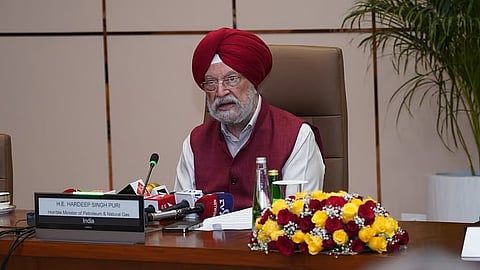
“In a major decision, 20 percent of the average monthly Commercial LPG requirement will be allocated from today by OMCs, in coordination with the State Governments so that there is no hoarding or black marketing,” Minister for Petroleum and Natural Gas Hardeep Singh Puri said in a statement in the Lok Sabha.
Commercial LPG is sold in a deregulated market where buyers can purchase cylinders without booking requirements or digital authentication, Puri noted, adding that such a structure can lead to diversion and speculative stocking during periods of supply stress.
To manage the situation, the government constituted a three-member committee comprising Executive Directors from Indian Oil Corporation, Bharat Petroleum Corporation Limited and Hindustan Petroleum Corporation Limited to assess demand and distribution challenges faced by commercial consumers such as restaurants.
The committee has held consultations with state civil supplies departments and restaurant associations to assess genuine demand by geography and sector, the minister said.
The minister said the government’s foremost priority is ensuring uninterrupted supply of cooking gas to households. “Modi Govt’s foremost priority is that the kitchens of India’s 33+ crore families, especially the poor and the underprivileged, do not face any shortage. Domestic supply is fully protected and the delivery cycle is unchanged,” Puri said.
He added that the standard time from booking to delivery of domestic LPG cylinders remains around 2.5 days, unchanged from pre-crisis norms. Hospitals and educational institutions have also been placed on uninterrupted priority supply.
To manage demand pressures, the government has also introduced restrictions on LPG cylinder bookings in certain areas. “A 25-day minimum booking gap has been introduced as a demand management measure in urban areas and 45 days in rural and durgam kshetra areas,” Puri said.
Field reports have indicated instances of panic booking and hoarding in some localities, driven by consumer anxiety rather than an actual supply shortage, the minister added.
The government is also expanding Delivery Authentication Code coverage to 90 percent of consumers, which requires users to confirm receipt of cylinders through a one-time code sent to their registered mobile number.
As was reported by PSU Watch, to ease pressure on LPG demand, the government has also activated alternate fuel options for some commercial and industrial consumers. “Alternate fuel options are being activated to ease pressure on LPG and gas channels. Kerosene is being made available through retail outlets and PDS channels, and fuel oil is being made available for industrial and commercial consumers,” Puri said.
The Ministry of Environment, Forest and Climate Change has advised State Pollution Control Boards to permit restaurants and hospitality establishments to temporarily use fuels such as biomass pellets, refuse-derived fuel and kerosene or coal for a period of one month.
The measures come as global energy supply chains face disruption following the closure of the Strait of Hormuz amid the conflict in West Asia. India previously imported around 60 percent of its LPG requirements from Gulf countries including Qatar, the UAE, Saudi Arabia and Kuwait.
“Procurement has now been actively diversified, with cargoes being secured from the United States, Norway, Canada, Algeria, and Russia, in addition to available Gulf sources,” Puri said.
Follow PSU Watch on LinkedIN
He added that refinery directives have increased domestic LPG production by 28 percent over the past five days.
“The world has not faced a moment like this in modern energy history… For the first time in recorded history, the Strait of Hormuz has been effectively closed to commercial shipping,” Puri told the House.
(PSU Watch– India's Business News centre that places the spotlight on PSUs, Bureaucracy, Defence and Public Policy is now on Google News. Click here to follow. Also, join PSU Watch Channel in your Telegram. You may also follow us on Twitter here and stay updated.)
