
- News Updates
- PSU Watch
- Defence News
- Policy Watch
- हिन्दी न्यूज़
- Jobs Watch
- States News
- Event News

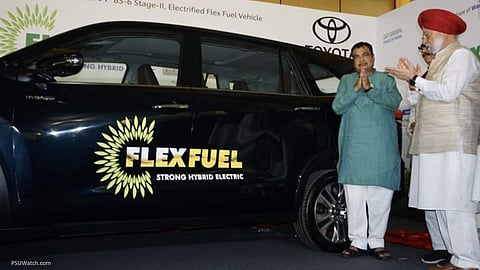
New Delhi: The Centre on Tuesday said it has not formulated any separate national policy to incentivise flex-fuel vehicles capable of running on fuel blended with more than 20 percent ethanol, indicating that there is currently no dedicated roadmap to promote higher ethanol-compatible vehicles.
In a written response, the Ministry of Heavy Industries also said it has not conducted any study on providing incentives for flex-fuel or electric vehicles, even as India pushes ahead with its ambitious ethanol blending programme.
Follow The PSUWatch Channel on WhatsApp
The clarification comes amid growing discussions on the next phase of India's biofuel strategy after the country achieved the target of 20 percent ethanol blending in petrol ahead of schedule. While several automobile manufacturers have introduced E20-compatible models and some have showcased flex-fuel vehicles, the government has not announced any incentive framework to accelerate their adoption.
Defending the Ethanol Blended Petrol (EBP) Programme, the ministry said extensive laboratory testing and large-scale field experience have found no evidence that E20 petrol causes abnormal engine wear, corrosion or reduces vehicle life.
The government maintained that the blending programme has not only reduced India's dependence on imported crude oil but has also helped shield consumers from fluctuations in international oil prices.
"The government has adopted a balanced approach to the Ethanol Blended Petrol Programme, ensuring that water sustainability, food security and farmers' interests remain paramount," the ministry said.
It noted that ethanol production has been diversified beyond sugarcane to reduce pressure on any single feedstock. Under the National Policy on Biofuels, ethanol can be produced from a range of approved raw materials, including sugarcane derivatives, maize, damaged foodgrains, broken rice, foodgrains unfit for human consumption, surplus foodgrains approved by the National Biofuel Coordination Committee (NBCC) and other approved agricultural feedstocks.
Addressing concerns over the environmental impact of ethanol production, particularly its water footprint, the ministry said an Expert Committee constituted by the Ministry of Agriculture and Farmers Welfare in 2024 had examined the water requirements of various ethanol feedstock crops. The committee's recommendations, it added, are being factored into the implementation of the blending programme.
Follow PSU Watch on LinkedIN
The government's response suggests that while it remains committed to expanding ethanol use as part of its energy transition strategy, any move towards promoting vehicles capable of using ethanol blends beyond E20 is yet to be backed by a dedicated policy or financial incentive framework.
(PSU Watch is India's Business News centre that places the spotlight on PSUs, Bureaucracy, Defence and Public Policy. 👉 Click to join our channel now: PSUWatch WhatsApp Channel. Prefer LinkedIn? Follow PSU Watch on LinkedIN. Click to stay connected on Twitter here and stay updated)

