
- News Updates
- PSU Watch
- Defence News
- Policy Watch
- हिन्दी न्यूज़
- Jobs Watch
- States News
- Event News

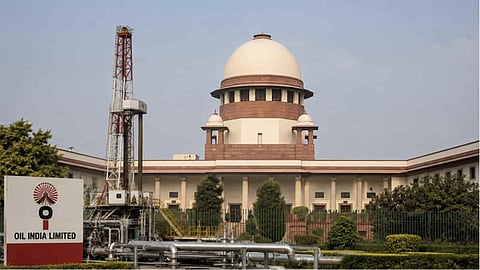
New Delhi: The Supreme Court has allowed state-owned Oil India Ltd (OIL) to withdraw an application challenging the Centre’s rejection of its extended-reach drilling proposal beneath Assam’s Dibru-Saikhowa National Park and approach the court through a fresh petition.
The order, passed on Wednesday by a bench comprising Chief Justice Surya Kant and Justices Joymalya Bagchi and V Mohana, gives OIL another legal route to challenge the rejection. It does not approve the drilling project or decide whether the proposed operation can be treated differently from mining.
Follow The PSUWatch Channel on WhatsApp
Senior advocate Rakesh Dwivedi, appearing for OIL, sought an urgent hearing and told the bench that the project was important for the country’s energy requirements.
“This is extremely urgent because the area is on the fringes of a national park. All permissions have been granted, but the government considers itself bound by a 2023 order of this court banning mining. This is not mining. The pipeline is being laid outside the park. It goes 4,000 metres underground and then proceeds horizontally,” Dwivedi submitted.
OIL had filed the interlocutory application in the long-running T N Godavarman Thirumulpad vs Union of India forest-conservation case. The court registry, however, declined to number the application because of an earlier judicial direction restricting the filing of further miscellaneous applications in that proceeding.
The Chief Justice said OIL could institute a separate petition if its challenge arose from a fresh cause of action.
“We wanted to close that entire matter. If there is a fresh cause, file a fresh petition and we will entertain it. The registry cannot list the interlocutory application because there is an order to that effect,” the Chief Justice said.
Following OIL’s request, the bench allowed the application to be withdrawn with liberty to file a fresh petition. There was no reported adjudication on Thursday on the environmental or legal merits of the project. The News Mill
The dispute arises from the Ministry of Environment, Forest and Climate Change’s refusal to permit the non-forest use of 0.069 hectares of forest land for extended-reach drilling from the Baghjan petroleum mining lease area in Tinsukia district.
OIL has challenged the ministry’s August 2, 2024 decision as well as the Forest Advisory Committee’s deliberations of July 4, 2024.
At the centre of the dispute is whether extended-reach drilling, or ERD, should be covered by the Supreme Court’s April 26, 2023 directions restricting mining inside national parks and wildlife sanctuaries and within one kilometre of their boundaries.
The company argues that ERD is fundamentally different from conventional mining because its drilling pads and surface infrastructure would remain outside the national park. Wells would first be drilled vertically to depths of around 3,500 to 4,000 metres and then extended horizontally to reach hydrocarbon deposits beneath the protected area.
That distinction remains OIL’s contention and is yet to be judicially accepted in the present dispute.
Dwivedi told the court that the project was connected to nearly 3 percent of India’s oil requirement. The submission was made on behalf of OIL, but the reported proceedings did not provide the production estimates or timeframe underlying the figure.
The PSU has relied on earlier Supreme Court orders from 2017, which it says permitted subsurface hydrocarbon extraction beneath Dibru-Saikhowa through ERD technology, subject to environmental safeguards and other conditions.
OIL has also cited the Standing Committee of the National Board for Wildlife’s recommendation for the proposal and an environmental clearance issued in May 2020 for exploratory drilling and hydrocarbon testing at seven locations beneath the park. Separate forest approval was nevertheless required wherever forest land was proposed to be used.
Follow PSU Watch on Linked
The company’s earlier application sought directions requiring the Environment Ministry to approve the use of the 0.069 hectares under the Van (Sanrakshan Evam Samvardhan) Adhiniyam, 1980.
Once OIL files its fresh petition, the court will have to examine the substantive question left untouched by Wednesday’s order: whether drilling from outside a protected area to extract hydrocarbons beneath it falls within the restrictions imposed on mining around national parks, and whether earlier approvals can override or coexist with the 2023 directions.
(PSU Watch is India's Business News centre that places the spotlight on PSUs, Bureaucracy, Defence and Public Policy. 👉 Click to join our channel now: PSUWatch WhatsApp Channel. Prefer LinkedIn? Follow PSU Watch on LinkedIN. Click to stay connected on Twitter here and stay updated)

