
- News Updates
- PSU Watch
- Defence News
- Policy Watch
- हिन्दी न्यूज़
- Jobs Watch
- States News
- Event News


New Delhi: India’s total installed power generation capacity stood at 509.74 GW as on November 30, according to the latest installed capacity data released by the Central Electricity Authority (CEA). The data reflects a major structural shift in the country’s power sector, with renewable energy capacity now closely tracking thermal capacity in absolute megawatt terms.
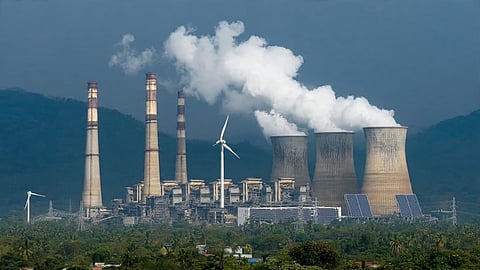
As per the data, thermal power capacity — including coal, lignite, gas and diesel — stood at 246.94 GW, while renewable energy capacity reached 254.02 GW at the end of November. This places the two segments at near parity in MW terms, underscoring how sustained renewable additions over recent years have narrowed the gap with conventional generation in absolute capacity terms rather than as a percentage of the mix.
Solar power continues to dominate India’s renewable capacity base. Of the 254.02 GW of installed renewable capacity, solar alone accounts for 132.85 GW, more than half of the total.
Wind power capacity stood at 53.99 GW, while small hydro projects accounted for 5.16 GW. Bio-power, including waste-to-energy, contributed about 10.76 GW, according to the renewable energy break-up compiled from MNRE data.
Despite the narrowing gap with renewables, coal remains the backbone of India’s thermal generation fleet, with installed coal-based capacity at 219.61 GW. Gas-based capacity stood at 20.12 GW, while lignite capacity was 6.62 GW and diesel-based capacity just 0.59 GW, highlighting the continuing dominance of coal within the thermal segment even as new capacity additions increasingly tilt towards renewables.
The November data also highlights the momentum behind renewable additions. During the month, net renewable capacity addition stood at 3,311.53 MW, compared with 1,320 MW of net thermal capacity addition.
Overall, India added a net 4,631.53 MW of generation capacity in November, with renewables accounting for more than two-thirds of the incremental capacity added during the month.
India’s installed nuclear power capacity remained unchanged at 8.78 GW as of November-end, indicating that while several large nuclear units are under construction, additions to the installed base continue to lag behind renewable and thermal capacity growth in the near term.
Ownership-wise, the data shows the private sector as the dominant owner of generation capacity, with 278.56 GW of installed capacity. The Central sector accounted for 119.22 GW, while state utilities held 111.96 GW, reinforcing the long-term shift towards privately owned generation assets across both renewable and thermal segments.
Regionally, installed capacity remains concentrated in a few parts of the country. The western region led with about 173.07 GW, followed by the northern region at 149.69 GW and the southern region at 142.80 GW.
In contrast, the eastern region accounted for 38.78 GW, while the north-eastern region had just 5.24 GW of installed capacity, highlighting persistent regional imbalances in generation infrastructure despite nationwide capacity expansion.
(PSU Watch– India's Business News centre that places the spotlight on PSUs, Bureaucracy, Defence and Public Policy is now on Google News. Click here to follow. Also, join PSU Watch Channel in your Telegram. You may also follow us on Twitter here and stay updated.)
