
- News Updates
- PSU Watch
- Defence News
- Policy Watch
- हिन्दी न्यूज़
- Jobs Watch
- States News
- Event News


Public institutions do not survive on authority alone. They survive on trust. And trust is built not merely through decisions but through the visibility and credibility of the process behind those decisions. The Public Enterprises Selection Board (PESB), India's apex public sector head-hunter, is expected to understand this better than most institutions because it sits at the heart of one of the government's most critical functions: choosing chairmen/directors for state-owned enterprises.
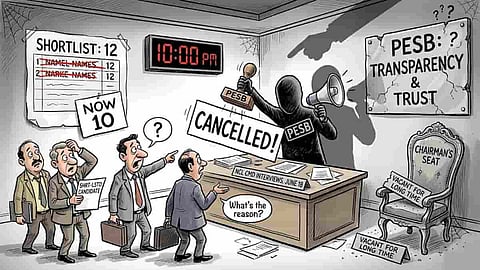
That is why the abrupt cancellation of the June 18 interview for the post of Chairman and Managing Director (CMD) of National Coalfields Limited (NCL) deserves attention beyond routine administrative reporting. The incident is not merely about one delayed appointment or one interrupted recruitment process. It is about larger questions of transparency, accountability and institutional credibility.
Follow The PSUWatch Channel on WhatsApp
The sequence of events itself appears unusual
The fulltime CMD position at NCL has remained vacant for a considerable period. PESB had completed the preliminary process and shortlisted twelve candidates for interviews scheduled on June 18. In the shortlisted candidates, three were from Coal India Ltd: Om Prakash Mishra (Executive Director), Anand (Executive Director) and Anjali Kumar (Executive Director). Three were from South Eastern Coalfields Limited: Darla Sunil Kumar (Director Finance), Franklin Jai Kumar (Director technical) and Ramesh Chandra Mohapatra (Director technical- Project & Planning). Two from Central Coalfields Ltd: Pawan Kumar Mishra (Director Finance), Chandrashekhar Tiwari (Director Technical & Operations), and one each from Eastern Coalfields, NALCO, Indian Oil and Railways: Md. Anzar Alam (Director Finance-ECL), Pankaj Kumar Sharma (Director Production- NALCO), Piyush Mittal (Executive Director- Indian Oil Corporation Limited) and Anoop Kumar Sawai (Chief Safety officer- Southeast Central Railway). Candidates had prepared themselves for an important career milestone. Travel plans, schedules and professional commitments would naturally have been aligned with the process.
Then, at the eleventh hour on the night before the scheduled interview, the candidates were reportedly informed that the interview had been cancelled.
No reason was stated!
No further communication followed!
No clarification emerged!
No revised schedule was announced!
The process simply entered a zone of silence!
This is where concern begins!!
To be clear, there may exist entirely legitimate reasons behind the cancellation. Administrative complications may occur. Policy-level considerations sometimes intervene. Legal questions occasionally emerge. Here, responsible journalism demands restraint in assigning motives where evidence does not exist. But responsible institutions carry obligations too. They cannot ask stakeholders and the public to suspend questions indefinitely in the absence of information.
The issue is not merely that an interview was cancelled. The issue is that a process involving the selection of leadership for a major Coal India subsidiary and coal PSU was apparently halted without any explanation whatsoever.
And that creates a transparency deficit.
A transparency deficit is dangerous because it creates a vacuum, and in public life, vacuums rarely remain empty for long. They become breeding grounds for speculation, assumptions and suspicion.
Suspicion deepens
Now in the subsequent days, two of the twelve originally shortlisted candidates have been selected as directors in separate PESB interviews conducted on June 22 and June 23. Both were EDs. Anjani Kumar was chosen as Director Technical of Western Coalfields Ltd and Anand became Director (Technical) of BCCL. Which means the effective pool of candidates now appears reduced to 10. So the questions arise here are:
Will PESB proceed with these 10?
Will the shortlisting process be reopened?
Will new candidates be added?
Will the earlier shortlist remain valid?
Will candidates who were not shortlisted initially get another opportunity? Like the one director, that we do not wish to name here, who sent an email of representation to PESB asking clarification on the criteria of shortlisting because according to the advertised qualifications, he claimed that he should have been shortlisted!
These are not procedural footnotes. They concern fairness itself.
Suppose the shortlist is revised. On what basis will that revision occur? If additional names are included now, a question immediately follows: why were those names not shortlisted in the first place?
Follow PSU Watch on LinkedIN
Conversely, if the process resumes with only the remaining candidates, another question emerges: does the altered candidate pool change the competitive landscape compared to what originally existed?
Such questions require answers because recruitment for top public sector leadership positions is expected to operate under principles of consistency and predictability.
But beyond these procedural concerns lies an even more uncomfortable issue.
Was the interview cancelled because some names were missing from the shortlisted list?
The question may sound uncomfortable, but uncomfortable questions often emerge from opaque systems.
Again, there is no evidence presently available to support such a conclusion. Any direct allegation would be irresponsible and unfair. But journalism is not merely about proving events after they happen. It is also about examining whether circumstances create conditions where reasonable questions naturally arise.
And here they certainly do.
Because if an interview process reaches the final stage—with candidates shortlisted, schedules prepared and interactions fixed—only to be halted at the last moment without explanation, people inevitably begin searching for explanations on their own.
Was there dissatisfaction with the shortlisted pool?
Did some stakeholders raise objections?
Were there administrative interventions?
Were procedural concerns identified at the eleventh hour?
Or was there pressure to reconsider eligibility or inclusion?
Follow The PSUWatch Channel on WhatsApp
The absence of official information means nobody outside the process knows. And that itself is the problem. Institutions like PESB should never allow a situation where speculation becomes the primary source of information.
The irony here is that PESB itself has historically maintained mechanisms intended to create procedural transparency. In cases where interviews are conducted but no candidate is found suitable, PESB publicly declares the outcome as "No Candidate Selected."
That practice serves an important purpose. It tells stakeholders that the process occurred.
It tells them the candidates were evaluated. It tells them a decision was reached. And most importantly, it tells them that the institution has nothing to hide.
What happened in this case appears different. The process did not conclude publicly. It simply vanished from view. Not even shortlisted candidates were informed why has it been cancelled, if the interview has been rescheduled for a new date, if there will be fresh shortlisting, nothing!
Transparency Deficit at the PESB
Questions around transparency at PESB are not entirely new. Across public sector circles, discussions often emerge around delays in appointments, prolonged vacancies and decision-making processes that appear difficult for outsiders to understand. None of these issues automatically indicate wrongdoing. Bureaucratic systems are often complex by nature.
Follow PSU Watch on LinkedIN
But complexity cannot become an excuse for opacity.
Public institutions increasingly operate in an environment where citizens expect greater transparency than before. Government bodies now routinely publish notifications, explanations, timelines and procedural updates. Information flows faster and public scrutiny is more intense.
PESB cannot remain insulated from these expectations.
The body is not selecting middle-management personnel. It is identifying individuals who eventually lead some of India's most strategically significant enterprises. Such positions involve enormous financial responsibility, national resources and public interest.
Consequently, the process itself must remain beyond question.
Not beyond scrutiny—beyond question.
There is a difference.
No institution in a democracy should be immune from scrutiny. In fact, scrutiny strengthens institutions because it improves accountability. But institutions should operate in ways that minimise avoidable doubts.
The NCL episode has unfortunately achieved the opposite.
(PSU Watch is India's Business News centre that places the spotlight on PSUs, Bureaucracy, Defence and Public Policy. 👉 Click to join our channel now: PSUWatch WhatsApp Channel. Prefer LinkedIn? Follow PSU Watch on LinkedIN. Click to stay connected on Twitter here and stay updated)
